 Ovelia.appAvailable on the App Store
Ashwagandha vs. Rhodiola: When to Use Each
Ashwagandha and rhodiola get thrown into the same 'stress support' bucket, but they are not interchangeable. If your pattern looks wired, anxious, and sleep-fragile, ashwagandha is usually the cleaner test. If it looks mentally fatigued, flat, and performance-drained, rhodiola is often the better fit.
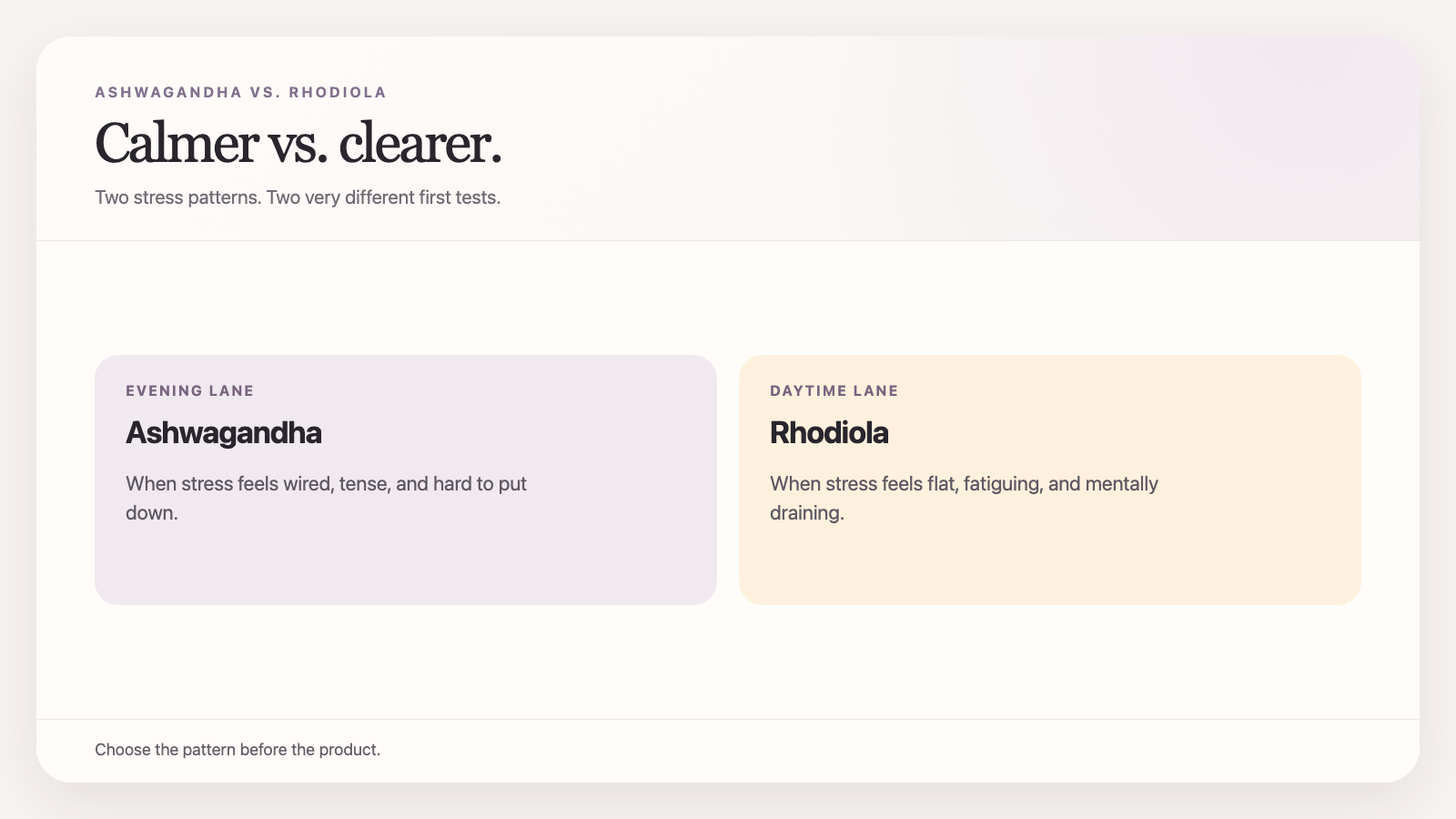 These are not twins. They solve different versions of the same modern problem.
Ashwagandha and rhodiola are constantly grouped together as "adaptogens," which is wellness-internet shorthand for herbs that might help you deal with stress. That label is not useless. It is just way too broad to help you choose.
The better question is not "which adaptogen is best?" It is: what kind of stress pattern are you actually trying to shift?
Some stress feels hot, wired, and anxious. You are tired but cannot fully downshift. Sleep gets lighter. Irritability goes up. Your body feels like it never got the memo that the day ended.
Other stress feels flat, mentally fatigued, and output-draining. You are not especially panicky. You are just spent. Focus gets worse, motivation gets thin, and work that should feel manageable starts to feel sticky.
Those are different problems. And they do not deserve the same supplement.
The simple split
If you want the blunt version:
- Ashwagandha is usually the better fit for a stressed, wired, anxious, or sleep-fragile pattern.
- Rhodiola is usually the better fit for mental fatigue, stress-related exhaustion, and "I need my brain back" days.
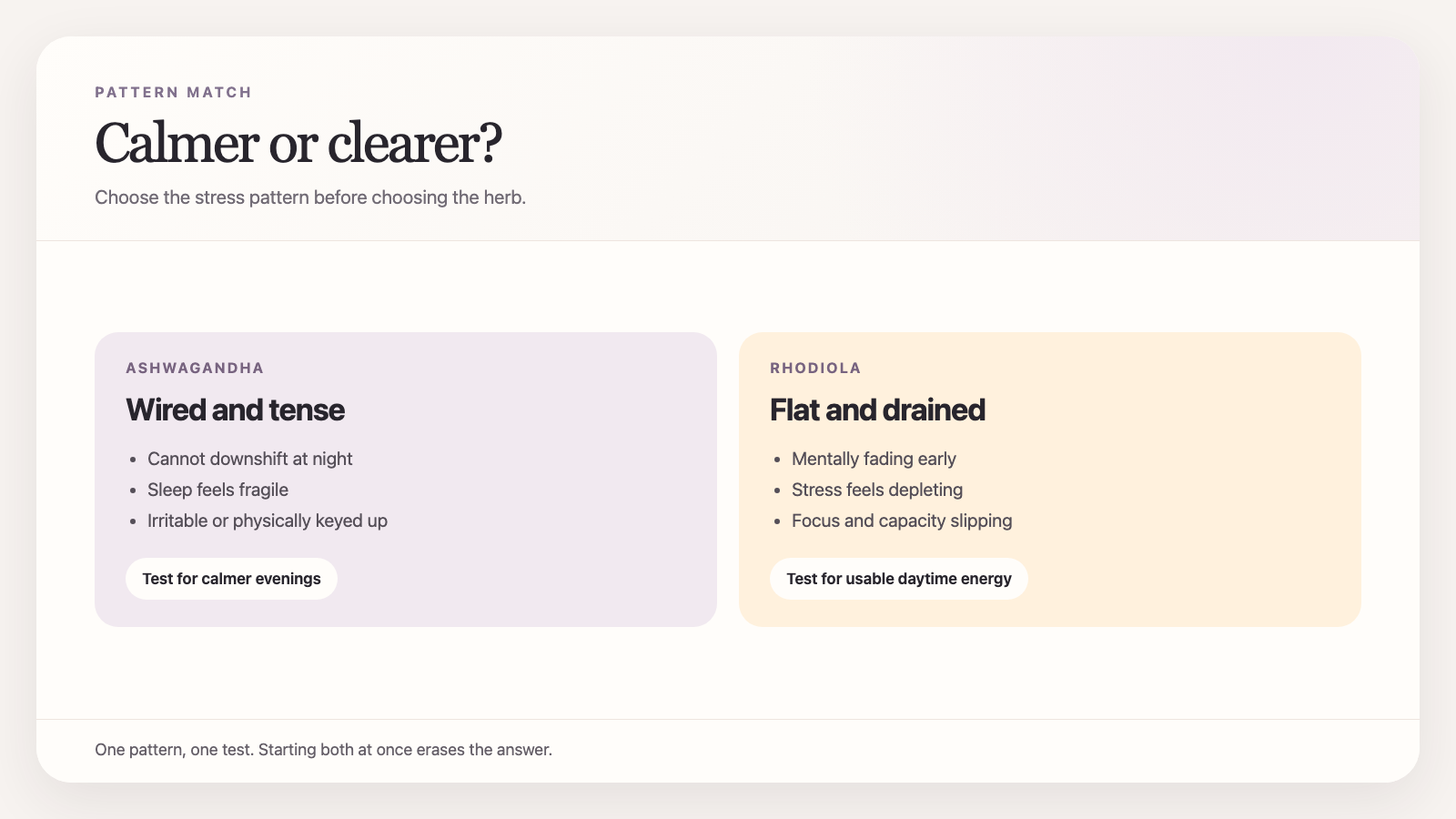 The useful distinction is not which herb sounds stronger. It is which stress pattern you are actually experiencing.
That is not because one is stronger. It is because the evidence and mechanisms point in different directions.
Ashwagandha makes more sense when stress feels heavy and sticky
Ashwagandha has the stronger modern evidence base for perceived stress and anxiety reduction.
The NIH Office of Dietary Supplements notes that multiple randomized trials and systematic reviews suggest ashwagandha can reduce stress and anxiety scores, often at doses around 240-600 mg per day of a standardized extract. A 2024 systematic review and meta-analysis found overall improvements in stress- and anxiety-related outcomes across randomized trials, though the studies were still relatively small and product quality varied.
That last part matters. Ashwagandha is not a pharmaceutical. It is a category with messy standardization. But the signal is strong enough that it has become one of the more defensible over-the-counter stress experiments.
Mechanistically, the appeal is pretty straightforward: ashwagandha appears to interact with the hypothalamic-pituitary-adrenal axis and may help lower stress reactivity, including cortisol in some studies. In real life, that tends to map best to women who feel overstimulated rather than simply depleted.
That usually looks like:
- trouble settling at night
- persistent tension or hypervigilance
- stress that bleeds into mood and sleep
- feeling "on" long after the workday is over
Ashwagandha is not magic, and it is not for everyone. It can cause GI upset, drowsiness, and in rare cases has been linked to liver injury. It also deserves more caution if thyroid issues are in the picture, because some case reports and mechanistic concerns suggest it can shift thyroid hormone dynamics.
That is the adult version of the conversation: useful, not casual.
Rhodiola makes more sense when stress feels like fatigue
Rhodiola has a thinner evidence base, but the lane is pretty consistent: stress-related fatigue, mental performance under strain, and recovery of output.
A systematic review of rhodiola trials found enough positive signal to keep it in the conversation, but also made the obvious point that many trials were small and methodologically weak. That means you should not read rhodiola content like it is proven the way creatine or caffeine are proven. It is not.
Still, the pattern matters. The most plausible use case for rhodiola is not "general wellness." It is the person whose stress is showing up as lower resilience to cognitive load and fatigue.
That usually looks like:
- mentally fading too early in the day
- stress that feels more draining than buzzy
- reduced work capacity during high-demand stretches
- flat motivation with intact sleep drive
If ashwagandha is "help me stop running hot," rhodiola is more like "help me keep output from collapsing under stress."
That is also why timing differs. Rhodiola is usually a daytime experiment. Ashwagandha is often better suited to later-day or evening use when the goal includes calming the landing.
The biggest mistake is using the wrong herb for the wrong pattern
This is where people waste a month and conclude that both herbs are overhyped.
If you are wired and anxious, rhodiola might feel like the wrong kind of lift.
If you are flat and mentally fatigued, ashwagandha might feel underwhelming or even a little too sedating.
Neither result means the herb category is fake. It usually means the pattern match was bad.
That is the part supplement content often skips because "take this for stress" is easier to market than "figure out which kind of stress you are actually having."
How I would test each one
Test ashwagandha if:
- your stress shows up as tension, irritability, or sleep disruption
- evenings feel hard to downshift
- you want calmer more than sharper
Reasonable test:
- standardized extract
- roughly 300 mg once or twice daily depending on the product
- 6 to 8 weeks
- track tension, sleep onset, overnight waking, and perceived stress
Test rhodiola if:
- your stress shows up as fatigue and mental drag
- your main complaint is diminished capacity, not anxiety
- you want more usable daytime energy, not a sedating effect
Reasonable test:
- standardized extract, usually earlier in the day
- 4 to 6 weeks
- track focus, fatigue, stress tolerance, and late-afternoon drop-off
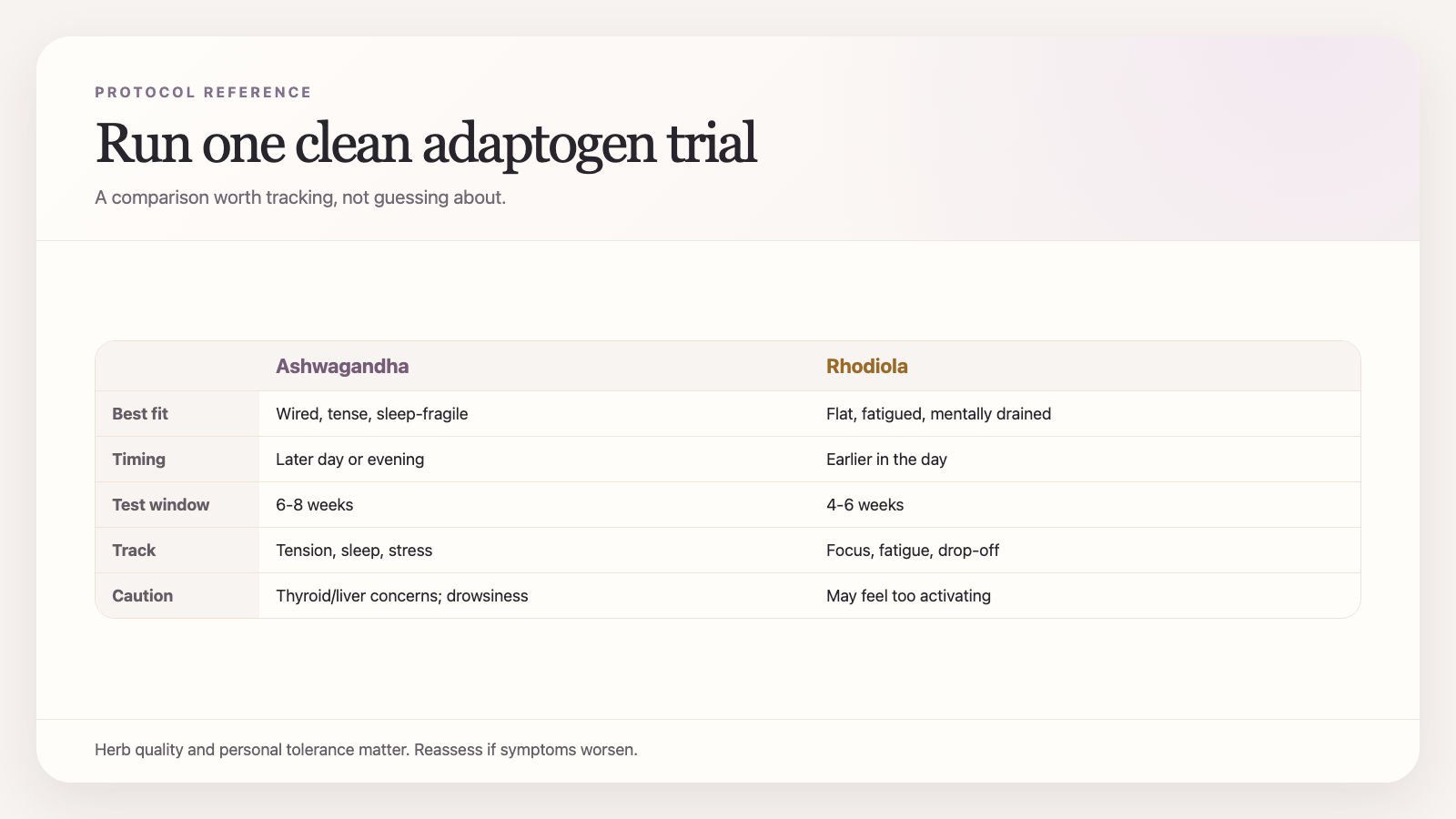 One clean test gives you an answer. A blend mostly gives you attribution problems.
Do not start both at once unless your goal is to learn nothing.
What to track
These herbs are perfect examples of why intuition is overrated.
If you take ashwagandha for two weeks and happen to sleep better because work cooled off, you will over-credit the herb.
If you take rhodiola during a brutal launch week and still feel tired, you will under-credit it.
Track a tiny handful of things:
- stress intensity
- energy quality
- sleep quality
- focus or cognitive stamina
Not fifty things. Just enough to compare baseline against the experiment.
This is exactly the kind of lightweight protocol Ovelia is good for. Not because herbs need more hype, but because stress is messy and memory lies.
The bottom line
Ashwagandha and rhodiola belong in the same broad category, but not in the same recommendation sentence.
If your pattern is anxious, wired, tense, and sleep-fragile, start with ashwagandha.
If your pattern is stress-related fatigue, mental drag, and reduced output, start with rhodiola.
Pick one. Run it long enough to read. Then decide.
That is the move. Not buying both because the bottle said "adaptogen blend."
Sources:
- Ashwagandha: Is it helpful for stress, anxiety, or sleep? Health Professional Fact Sheet
- Effects of Ashwagandha (Withania Somnifera) on stress and anxiety: A systematic review and meta-analysis
- An investigation into the stress-relieving and pharmacological actions of an ashwagandha extract: A randomized, double-blind, placebo-controlled study
- Rhodiola rosea for physical and mental fatigue: a systematic review
Ready to track what actually works for you?
Ovelia turns what you read into a guided protocol you can actually follow.