 Ovelia.appAvailable on the App Store
B Vitamins and Energy: Which Ones Matter, Which Forms Help, and When
B vitamins can matter a lot when deficiency or absorption issues are in play, but they are not instant caffeine. The practical move is to pick the right form, use the right time of day, and track whether energy and clarity actually improve.
 B vitamins are useful. They are just not a shot of ambition in capsule form.
People talk about B vitamins like they are the supplement equivalent of turning the lights on.
That is the wrong mental model.
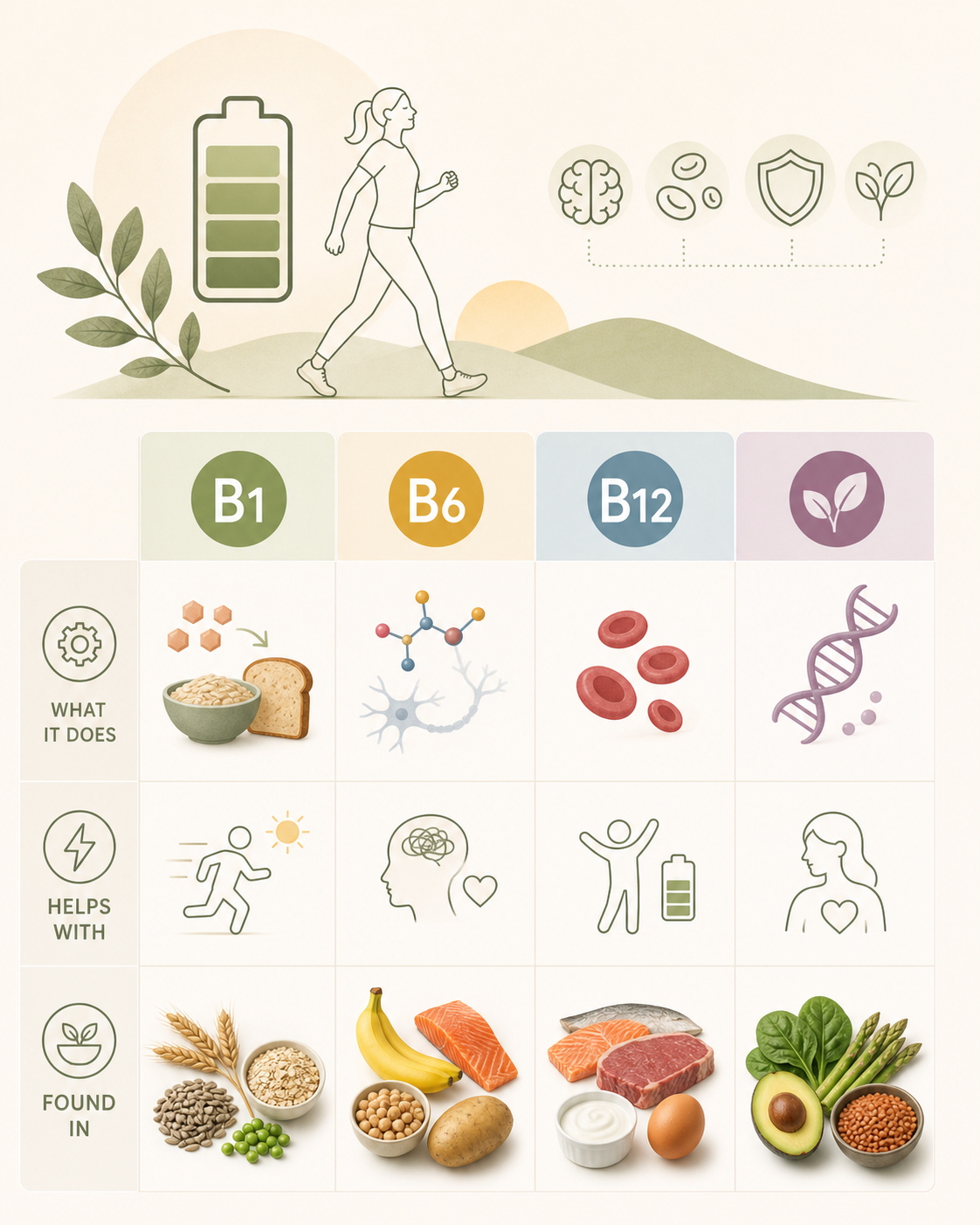
B vitamins matter because they help the body do a lot of the chemistry involved in energy metabolism, red blood cell formation, and nervous system function. But if you are already getting enough and you are not deficient, taking more usually does not create a dramatic "I feel awake now" effect. Sometimes it does nothing. Sometimes it just makes your urine look expensive.
The better question is not "Should I take B vitamins?" It is "Which ones matter, in what form, and in what situation?"
Deficiency correction is the real lane
The biggest reason B vitamins help is boring: they correct a problem.
Low B12, low folate, and certain other B-vitamin issues can show up as fatigue, weakness, brain fog, or other energy complaints. That is not the same as a healthy person taking a random B-complex because the label promised metabolism support.
If someone is tired and the cause is a deficiency, B vitamins can help a lot. If the cause is sleep debt, stress, under-eating, low iron, or too much caffeine, B vitamins are not a magic override.
Which ones matter most
B12
B12 is the one people hear about most for energy because deficiency can be very real and very disruptive. It matters for nerve function and red blood cell production. Older adults, vegans, people with absorption issues, and some people on certain medications are more likely to run into trouble.
Folate
Folate is another important one because it is deeply involved in cell division and red blood cell formation. Low folate can absolutely matter, but that does not mean more is always better.
B6
B6 is often marketed as a mood or energy helper, but the useful frame is support, not rescue. It participates in neurotransmitter and metabolism pathways, which is why it sometimes shows up in discussions about energy and PMS.
B1 and B2
These matter too, but they usually enter the conversation through broader nutritional adequacy rather than as standalone trend ingredients.
Forms matter more than the hype suggests
Different forms exist for a reason.
- B12 may appear as methylcobalamin, cyanocobalamin, or other forms
- folate may appear as folic acid or methylfolate
- B6 may appear as pyridoxine or P-5-P
That does not mean the fanciest form is always best. It means the context matters. Absorption, tolerance, and dietary pattern all matter more than whatever an algorithm shouted at you this morning.
 The form is not the whole story, but it is also not nothing.
Why some people feel wired
This is the annoying part.
Some people take a B-complex and feel more alert. Others feel a little edgy, nauseous, or weirdly overstimulated. That can happen because the product is too strong, the timing is wrong, or the person simply did not need that much.
B vitamins are not stimulants in the caffeine sense. But the body can still react to them in ways that feel "too up" if the dose or timing is off.
Morning is usually the safer bet if someone wants to test a B-complex. Night is usually a dumb experiment unless there is a specific reason.
What not to do
Do not assume:
- more B vitamins means more energy
- one strong B-complex is automatically better than a targeted approach
- a multivitamin proves anything about your actual energy status
Also do not ignore the obvious. If your fatigue is really sleep debt or low iron, a B vitamin will not rescue you.
 Morning is usually the cleaner test if you want a readable answer.
What to track
If you test B vitamins, track:
- energy level
- mental clarity
- stomach tolerance
- any wired or anxious feeling
- whether the effect is real or just "I took something"
Give it enough time to see a pattern, but not so many variables that you lose the thread.
Bottom line
B vitamins help most when they are correcting something.
If you want the short version:
- B12 and folate matter a lot when deficiency or absorption issues are in play
- B6 can be helpful in some contexts, but it is not a universal energy fix
- forms matter, but context matters more
- morning tends to be the safer time to test
The goal is not to collect more Bs. It is to see whether the right one changes anything useful.
Sources:
Ready to track what actually works for you?
Ovelia turns what you read into a guided protocol you can actually follow.