 Ovelia.appAvailable on the App Store
Creatine for Women: What the Research Actually Says
Creatine is not just for men lifting heavy, and women may actually have more to gain because baseline stores tend to be lower. If you want to test it properly, use 3 to 5 g of creatine monohydrate daily for 4 to 6 weeks and track workout output, mid-day energy, focus, or mood before deciding whether it helped.
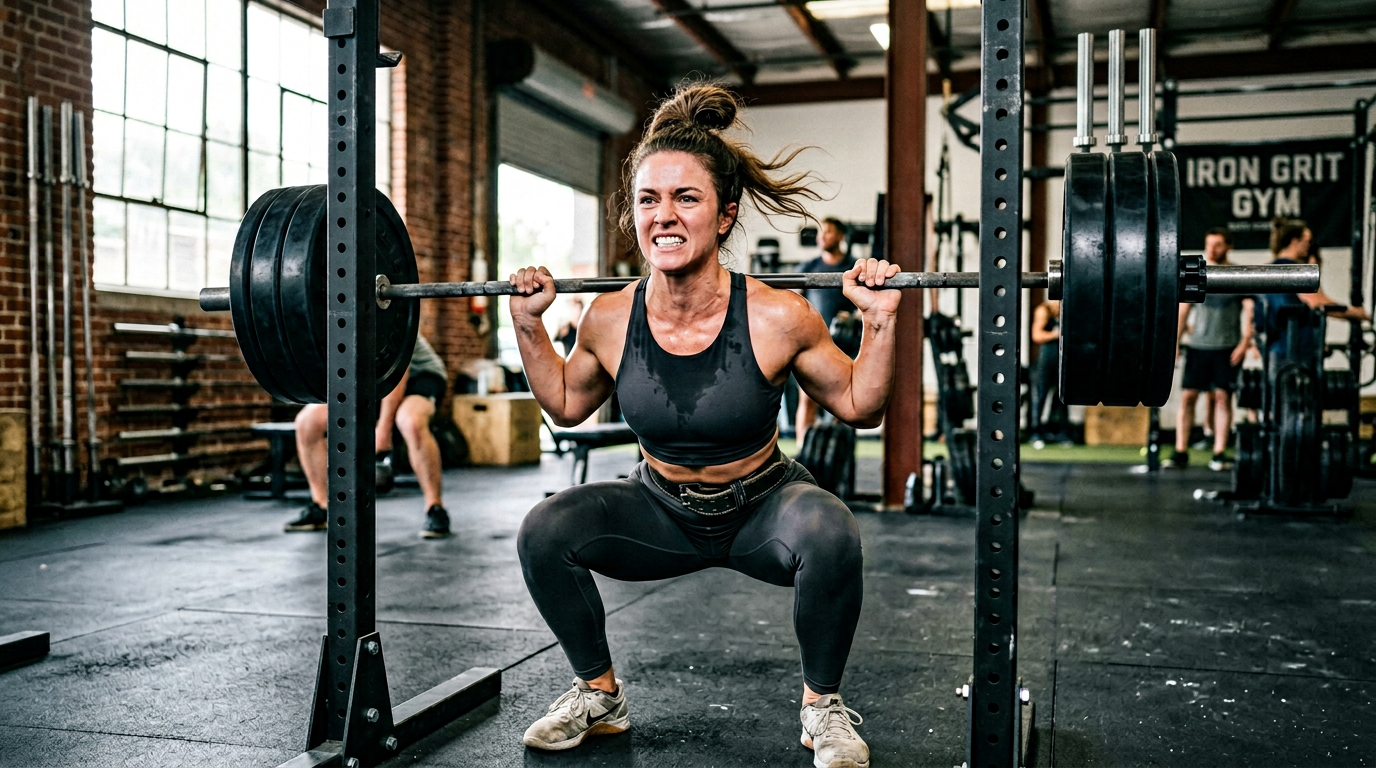 Creatine matters most in moments of real demand, not in before-and-after fantasy framing.
Creatine is the most-studied performance supplement in history — and most women have been told it's not for them.
The messaging has been consistent for decades: it's for men who lift heavy and want to get bigger. It'll make you hold water. It'll make you bulky. Most women believed it, skipped it, and moved on.
Which is a shame, because the research suggests women may have more to gain from creatine than men do. Not less.
Why women start behind
Females have 70–80% lower endogenous creatine stores than males. That gap exists because creatine is made from amino acids in the liver and kidneys (and absorbed from dietary meat), and women tend to eat less meat and carry less muscle mass. Most women are already well below baseline before they even consider supplementing.
Lower creatine stores mean less phosphocreatine — the compound the body uses to regenerate ATP rapidly during physical and mental effort. When demand is high and stores are low, performance suffers in ways that are easy to misattribute.
The lower your baseline, the more room there is to move. This is why the research suggests supplementation may be especially effective for women specifically.
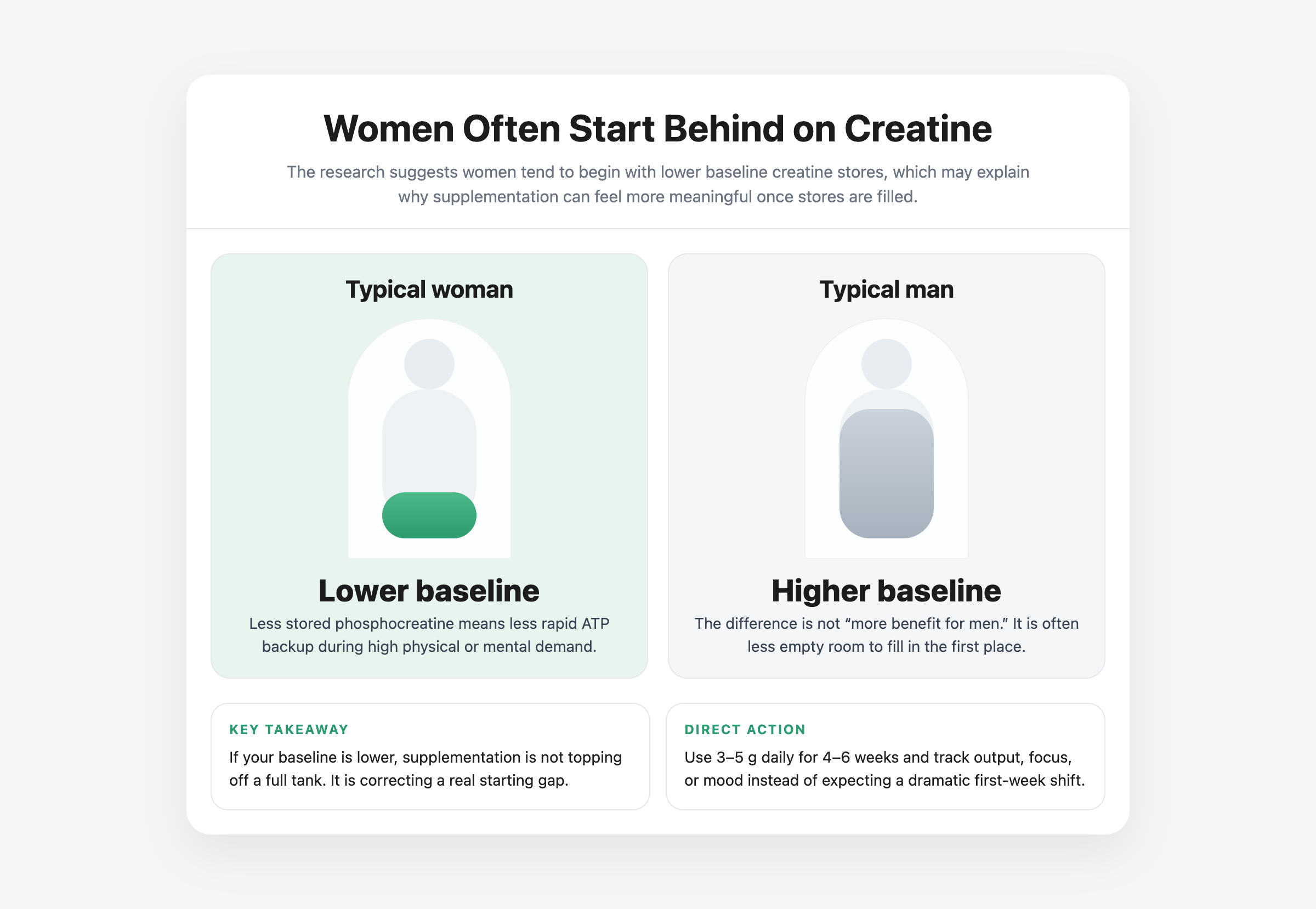 If you start with less stored creatine, filling the tank can feel more meaningful once you stay with it long enough.
Where most people get it wrong
Most women who've tried creatine did so for muscle. And the results can be hard to read.
Some weeks you feel stronger. Others, nothing seems different. The scale might shift a little. Your workouts feel slightly easier, but you can't tell if that's the creatine or just a good week. So you stop, or you decide it's not for you.
Creatine's effects don't announce themselves. They're gradual and spread across multiple systems — and without a baseline to compare against, you won't see them.
What the research covers
Muscle and exercise performance
For pre-menopausal women, creatine is reasonably well-established for improving strength and exercise performance. The effect isn't dramatic in isolation, but it's consistent: better ATP regeneration during hard effort means more output, faster recovery between sets, and over time, more adaptation from training.
Post-menopausal women show meaningful benefits in muscle size and function at higher doses (0.3 g per kilogram per day), with favorable effects on bone density when combined with resistance training. That matters more as you get older and muscle starts to go.
Brain and focus
This is the part most creatine content aimed at women skips.
Brain activity burns phosphocreatine fast. During high mental demand, creatine supports neural ATP resynthesis, giving the brain more capacity for tasks relying on the frontal cortex — attention, working memory, executive function. Women have lower creatine concentrations in the frontal lobe specifically, which may explain why the cognitive effects of supplementation often show up more strongly in women than men.
There's also a sleep deprivation angle that's easy to overlook. Sleep deprivation hits women harder than men on cognitive measures, and creatine has been shown to buffer mental performance under exactly those conditions. If you're running on five hours and trying to think clearly, this application is probably more relevant than anything happening in the gym.
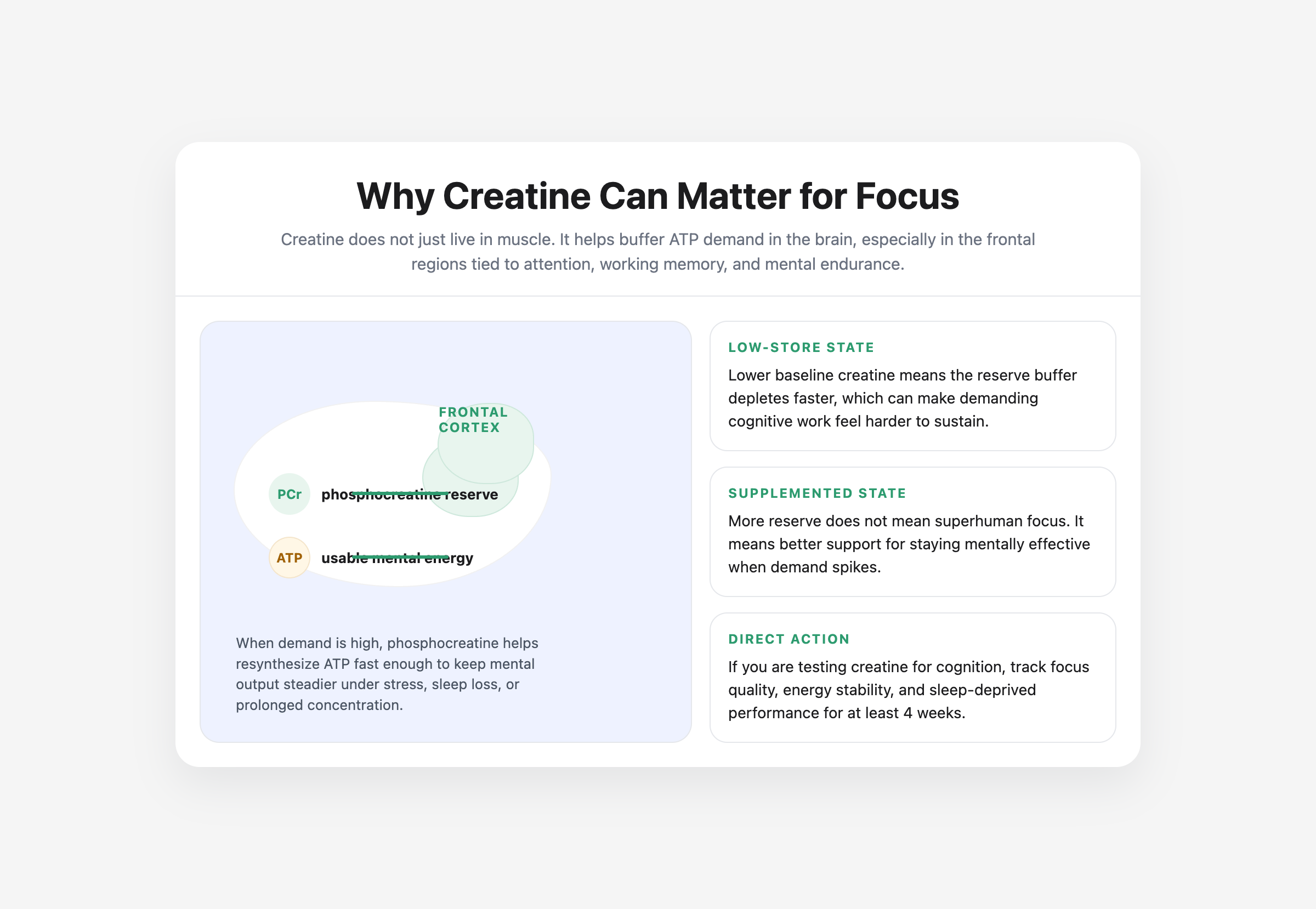 For women using creatine outside the gym, the cognition story is often the more relevant one.
Mood
The mood research is thinner, but the signal is there. Adults in the lowest quartile of dietary creatine intake have a 31% higher incidence of depression. When creatine was added to antidepressant treatment in women with major depression, depression scale scores improved within 2 weeks — versus the usual 4–5 week lag for antidepressants alone.
Creatine isn't a treatment for depression. But the brain's creatine system is clearly involved in mood regulation, and that matters more for women given how much cyclical hormone changes affect both brain creatine levels and depression risk across the lifespan.
The water weight thing
The scale will probably go up a little when you start. That's real — creatine pulls water into muscle cells, which is part of how it works. This isn't the same as bloating. The water goes into the muscle, not under your skin.
For most women, that means roughly 0.5–1 kg in the first couple of weeks, then it stabilizes. Better-hydrated muscle performs and recovers better. It's not fat gain.
What to take and when
3–5g of creatine monohydrate per day. That's what the research on women uses, and it's what works.
You can do a loading phase (20g/day for 5 days) to saturate stores faster, but it's not necessary. Daily 5g gets you there in 3–4 weeks with no GI stress. Either way, you end up at the same place.
Stick to monohydrate. Creatine HCl, ethyl ester, and other forms are marketed as better absorbed, but there's no consistent evidence they outperform monohydrate. And monohydrate is cheap.
Timing doesn't matter much. Around training, in the morning, at night — all fine. What matters is taking it every day. Creatine builds up in muscle and brain tissue over time, and breaking the habit means starting over.
What to track
Creatine's effects spread across muscle, energy, focus, and mood, which makes it genuinely hard to evaluate by feel. You might notice slightly better performance in the gym and credit your sleep. You might feel less foggy on a hard day and credit your coffee. Those things do interact — which is exactly why you need a baseline.
Track at least two variables for 4–6 weeks: workout output, mid-day energy, focus quality, mood. That window covers full creatine saturation and gives you enough signal to see whether anything actually changed.
If you want an easier way to keep that baseline and follow the pattern over time, Ovelia can help you track the supplement alongside focus, mood, energy, and training notes in one place.
The bottom line
Women have been systematically undercounted in creatine research and overcautioned by supplement marketing. The evidence, such as it is, points consistently toward real benefits in muscle, cognition, and mood — with effects that may be especially pronounced in women given where they start.
The 70–80% baseline deficit is real. The brain angle is genuinely underappreciated. And 3g a day costs almost nothing to try. It's not dramatic. It doesn't do anything fast or obvious. But it's one of the few supplements with enough research behind it that the question isn't really whether it works — it's whether it's working for you. That one takes data.
Sources:
- Smith-Ryan AE, et al. Creatine Supplementation in Women's Health: A Lifespan Perspective. Nutrients. 2021;13(3):877. PMC7998865
- Kaviani M, et al. Creatine in Women's Health: Bridging the Gap from Menstruation Through Pregnancy to Menopause. Journal of the International Society of Sports Nutrition. 2025. PMC12086928
Ready to track what actually works for you?
Ovelia turns what you read into a guided protocol you can actually follow.