 Ovelia.appAvailable on the App Store
Fibermaxxing: What It Is and What the Evidence Actually Says
Fibermaxxing is directionally right, but the real win is diversity, not obsessively chasing a trend number overnight. The easiest way to act on this is to add plant variety gradually each week by using beans, whole grains, berries, vegetables, herbs, spices, tea, and seeds rather than trying to force a huge fiber jump all at once.
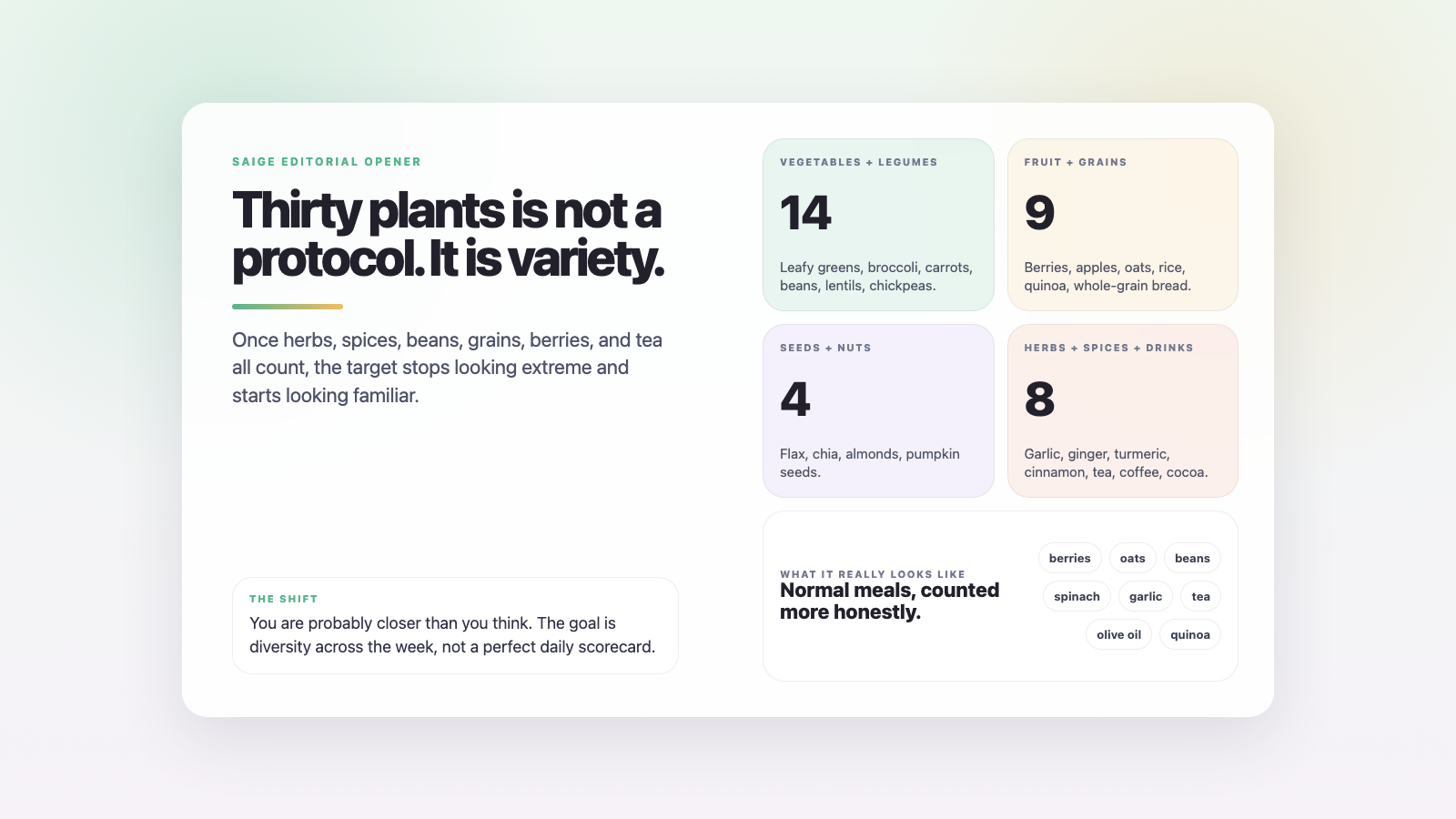 The surprising part is not that thirty plants is possible. It is that normal, varied eating gets you there faster than people assume.
The trend is real
Fibermaxxing went from niche wellness Reddit to mainstream social media fast. You've probably seen it: people stacking soluble fiber supplements, swapping refined carbs for whole grains, obsessing over "30 plants a week." The underlying logic sounds right. More fiber, healthier gut. But what's actually supported by science, and what's just hype?
The honest answer: the biology is solid. The execution is where most people mess up.
What the biology actually supports
Fiber isn't just "roughage" that moves things through. Different fibers ferment in your colon, and that fermentation is where the real action happens.
When you eat fermentable fiber (think oats, barley, beans, certain vegetables), your gut bacteria break it down and produce short-chain fatty acids. Mainly butyrate, propionate, and acetate. These aren't just byproducts. Butyrate in particular feeds the cells lining your colon, regulates pH, and influences metabolic health and immune function. Research shows these SCFAs play a direct role in maintaining gut integrity and managing inflammation.
Here's what Instagram posts miss: it's not about total fiber quantity. It's about diversity. The specific research backing the "30 plants per week" target comes from microbiome studies showing that dietary diversity correlates with greater bacterial diversity. More diverse bacteria means more metabolic flexibility in your gut. Different fiber types produce different beneficial compounds. One type alone won't cut it.
What fibermaxxing gets right and what it oversimplifies
Fiber diversity matters. Your microbiome responds to variety in ways a single fiber source can't. The bacteria that thrive on resistant starch are different from those that ferment pectin or beta-glucans. You need several.
Current intake recommendations sit at 30g daily, which reflects growing evidence that we're chronically under-fibered. Most people eating standard diets don't come close.
You don't need exotic supplements or complex protocols. The "30 plants" sounds impossible until you realize spices, herbs, seeds, and legumes count. A curry powder, a handful of beans, some berries, whole grains, and leafy greens add up fast.
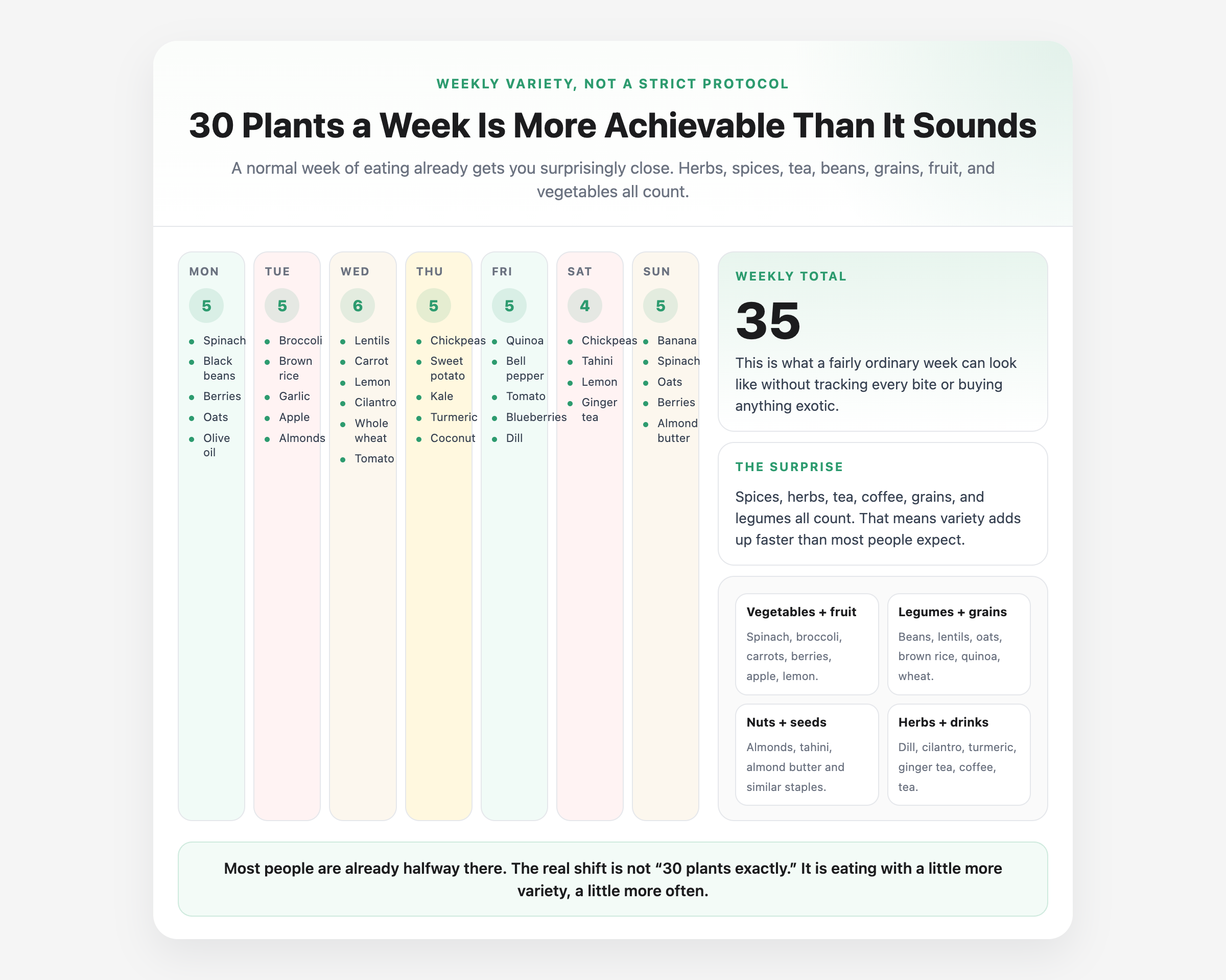 Herbs, spices, coffee, and tea count. Most people are already at 15–20 without realizing it.
The adjustment period is real and often dismissed. Going from low fiber to adequate fiber doesn't happen cleanly. Weeks 1 to 2 typically involve bloating, gas, and digestive discomfort as your bacteria population shifts and adapts to new fuel. This is normal. People interpret it as rejection when it's actually the microbiota reorganizing.
How to actually increase fiber without misery
Go slow. Add 5 to 10g per week, not 30g overnight. Hydration matters. Fiber without adequate water just backs things up.
Prioritize variety over quantity. Instead of "eat 30g of psyllium," think "eat different plant sources across the day." A serving of beans, some whole grain bread, berries, vegetables, a tablespoon of ground flax. Different works better.
If you're already eating a reasonable diet, you might need less of a jolt. If you're coming off low-fiber processed foods, expect a 2 to 3 week window where things feel uncomfortable. It passes.
What to actually track
This is where most people lose the thread. They feel bloated, assume fiber isn't working, and stop. Or they feel fine and have no idea if it's working because they're not measuring anything.
Bloating and gas in weeks 1 to 2 are normal signals of microbial fermentation, not dysfunction. Your memory is unreliable. You won't remember what your energy felt like 4 weeks ago. Gut symptoms shift day to day for reasons you won't intuitively understand (hydration, what you ate yesterday, stress, sleep).
That's why tracking matters. Log:
- Daily fiber intake (rough, not obsessive)
- Digestive symptoms (bloating, gas, energy, bowel regularity)
- How you feel compared to baseline
After 3 to 4 weeks of consistent intake, patterns emerge. You'll see whether increasing fiber actually changed your energy, digestion, or how you feel. Most people find that once the adjustment window passes, they feel noticeably better. Less energy crashes, more stable satiety, better digestion. But you need data to see through the noise.
The bottom line
Fibermaxxing isn't wrong. It's just incomplete. The trend got the "why" right: your microbiome needs diverse fiber. It skipped the "how": slowly, with variety, and with realistic expectations about the adjustment period.
Thirty plants per week is research-backed, not a gimmick. Your body needs adequate fermentable fiber to maintain a healthy microbiota. You get there through ordinary food diversity, not exotic protocols. And the transition is uncomfortable enough that logging it matters. Otherwise you'll give up during the phase where your gut is actually adapting.
Sources:
- Thomson C, Garcia AL, Edwards CA. Interactions between dietary fibre and the gut microbiota. Proc Nutr Soc. 2021 Sep 23;1-11. PMID: 34551829. https://pubmed.ncbi.nlm.nih.gov/34551829/
- Blaak EE, et al. Short chain fatty acids in human gut and metabolic health. Benef Microbes. 2020 Sep 1;11(5):411-455. PMID: 32865024. https://pubmed.ncbi.nlm.nih.gov/32865024/
Ready to track what actually works for you?
Ovelia turns what you read into a guided protocol you can actually follow.