 Ovelia.appAvailable on the App Store
GLP-1s and Supplements: What You Actually Need to Know
The biggest supplement issue on GLP-1 medications is usually not finding a magical add-on for more weight loss. It is protecting protein intake, muscle, micronutrient status, and tolerance while appetite is lower and food volume drops.
 The right question is not 'what stacks with GLP-1s?' It is 'what gets neglected once eating changes?'
GLP-1 medications have created a new kind of supplement confusion.
People start semaglutide or tirzepatide, appetite drops, food volume drops, weight comes down, and suddenly the supplement question becomes either:
- "what should I add to make it work faster?"
- or "what do I need to avoid falling apart while it works?"
The second question is the real one.
The biggest supplement issue on GLP-1s is usually not that you need a fancy metabolic stack. It is that lower intake can quietly create:
- inadequate protein
- lean mass loss
- micronutrient gaps
- hydration problems
- GI issues that make eating even harder
Why supplements come up so fast on GLP-1s
GLP-1 receptor agonists reduce appetite and energy intake. That is the point.
But once food volume drops, a lot of people do not just eat less energy. They also eat less:
- protein
- calcium-rich foods
- iron-rich foods
- B12-containing foods
- overall diet diversity
That matters because weight loss is not just fat loss. Some lean mass loss usually comes along for the ride. Review literature on GLP-1 body-composition effects suggests that roughly 15% to 45% of total weight loss can come from lean mass depending on context, population, and method.
That does not mean GLP-1s are bad. It means muscle protection is now part of the job.
The first supplement priority is usually protein
If you only remember one thing from this post, make it this:
Protein is usually the first nutrition problem on GLP-1s.
Lower appetite often means smaller meals, skipped meals, or meals that are easy to tolerate but too light on protein. Over time, that can make lean mass protection harder.
This is why recent narrative reviews on dietary intake during GLP-1 or dual GIP/GLP-1 therapy keep returning to inadequate protein intake as a central concern. It is also why body-composition reviews increasingly emphasize pairing these medications with resistance training and strategic protein intake.
For many people, the "supplement" question is just a practical one:
- Can you hit protein needs with food alone?
- If not, do you need a protein powder or ready-to-drink option that you can tolerate?
That is not glamorous. It is still the highest-value answer.
The second priority is micronutrient coverage
A 2025 narrative review on micronutrient and nutritional deficiencies associated with GLP-1 receptor agonist therapy highlights the obvious but important concern: lower intake can increase the risk of inadequate thiamine, cobalamin, iron, calcium, and other nutrients depending on diet pattern and symptom burden.
This is especially relevant if nausea, food aversions, constipation, or vomiting are reducing intake further.
That does not mean everyone on a GLP-1 automatically needs a giant supplement stack. It means you should care about whether your reduced intake is still nutritionally competent.
The third priority is not sabotaging muscle
Lean mass loss during weight reduction is not unique to GLP-1s. It happens with calorie restriction too. But GLP-1s can make the problem easier to ignore because the appetite effect feels so dominant.
The literature is pretty clear on the broad strategy:
- adequate protein
- resistance training
- regular reassessment if weight is dropping fast
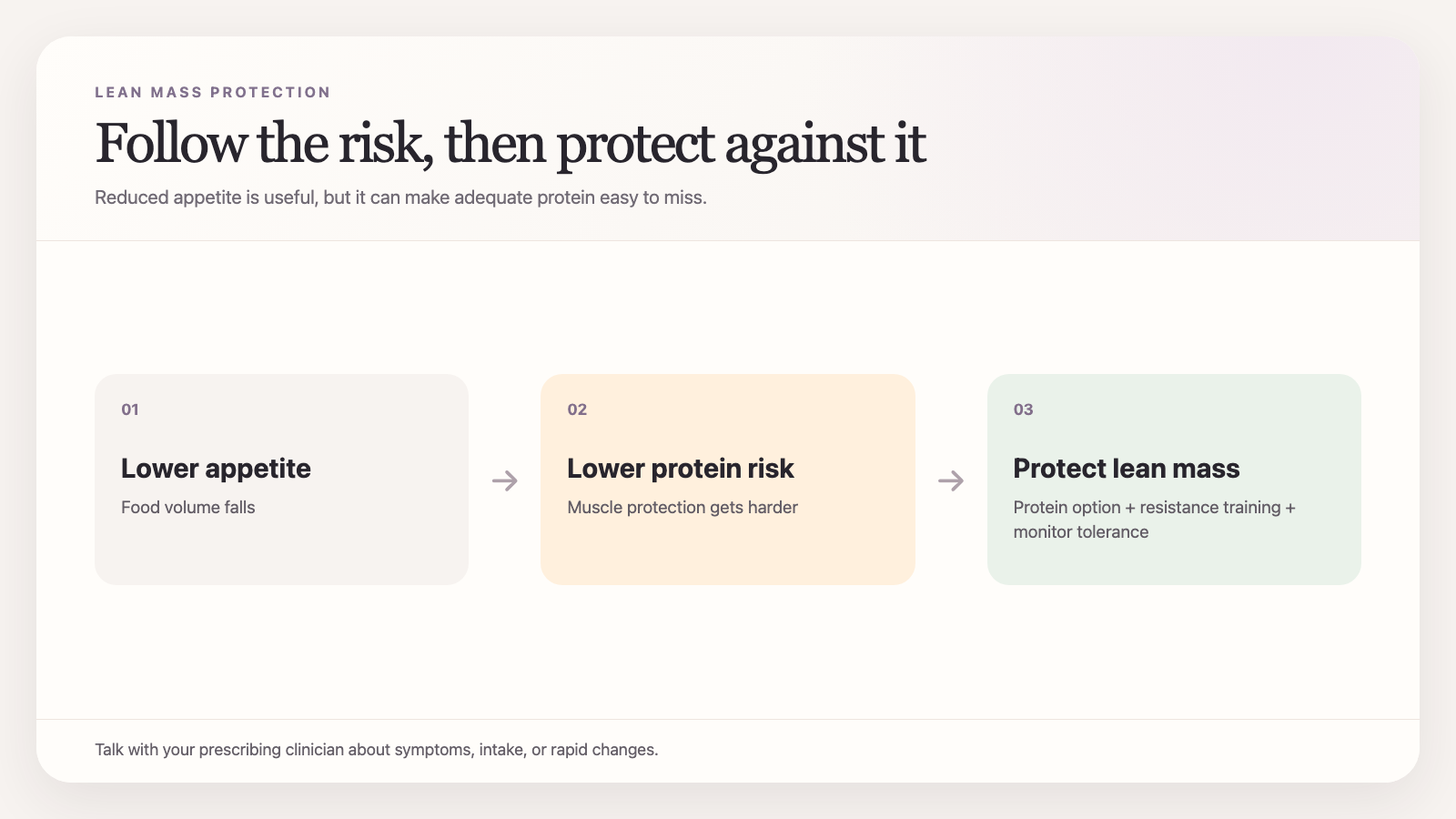 Lower appetite can quietly become lower protein unless muscle protection is treated as part of the plan.
If a supplement belongs in that conversation, it is usually a protein supplement, not a random fat-burner with prettier branding.
What about electrolytes, fiber, or digestive support?
These can matter, but they are secondary to the big structural issues above.
Electrolytes
Useful when lower intake, reduced food volume, vomiting, or lower-carb intake makes hydration shakier. Not everyone needs them. Some people clearly do better with them.
Fiber
Potentially helpful, especially when constipation shows up. But fiber on GLP-1s can be a finesse problem. If someone is already nauseated, overfull, or constipated, slamming large fiber doses into the system is not automatically kind.
Digestive support
Only if there is a specific symptom pattern. The answer is not "take more things because you are on a medication."
What I would not prioritize first
I would not make "GLP-1-boosting supplements" the center of the strategy.
Could some ingredients affect satiety or incretin physiology? Sure. But for a patient already on a GLP-1 medication, the more immediate problems are usually:
- eating enough protein
- preserving lean mass
- maintaining micronutrient sufficiency
- handling side effects well enough to stay nourished
You do not fix those with an aspirational capsule ad.
A cleaner support framework
If you are on a GLP-1 and trying to build a sensible supplement plan, think in this order:
- Protein sufficiency
- Resistance training
- Hydration and bowel regularity
- Micronutrient coverage if intake is clearly reduced
- Everything else
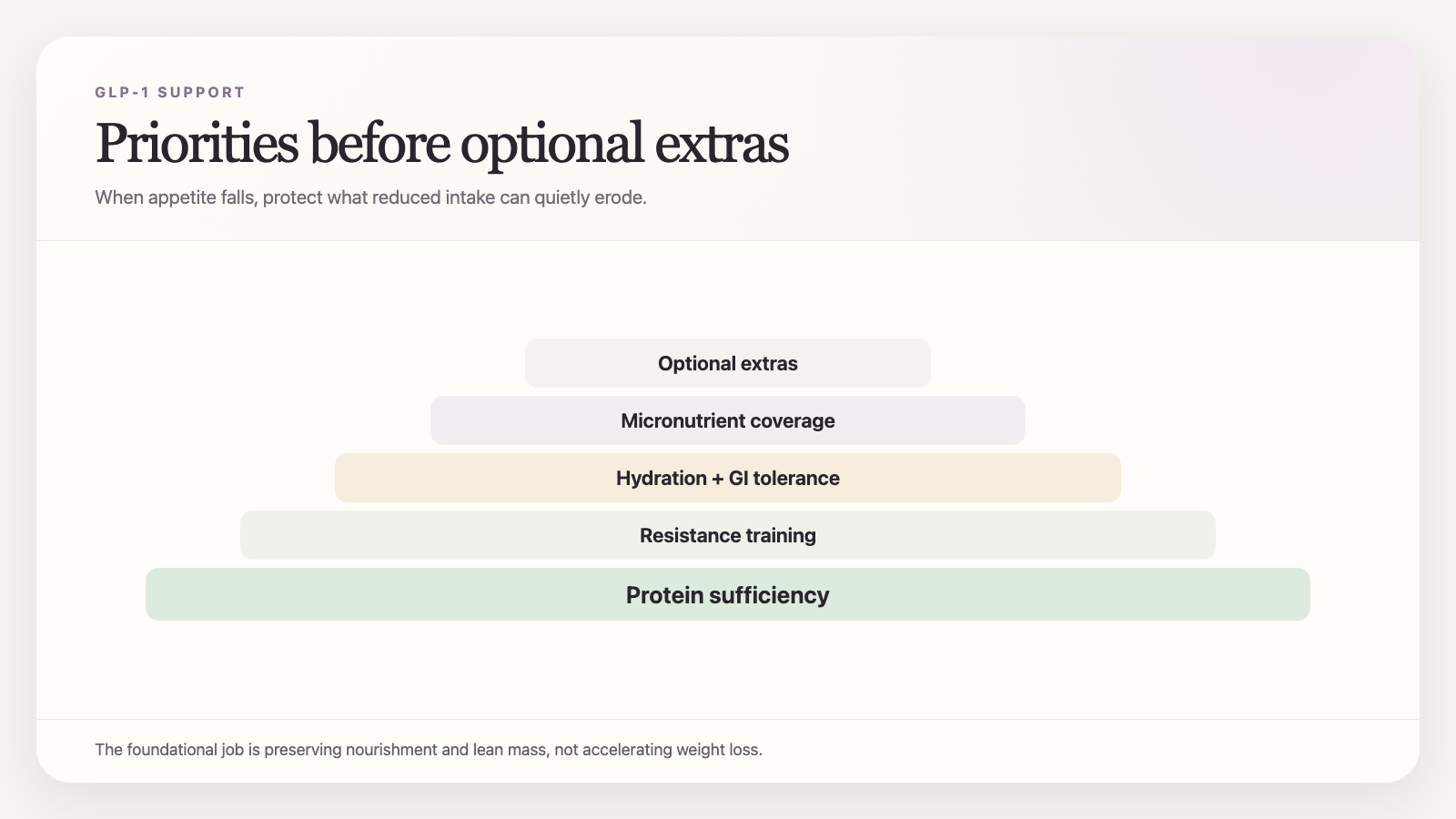 Protect the foundations first; optional add-ons are not the center of GLP-1 support.
That is the adult order of operations.
What to track
Track:
- protein intake
- strength or training consistency
- rate of weight loss
- GI tolerance
- hydration
- fatigue
That is enough to catch the big misses before they become bigger problems.
Ovelia is useful here because GLP-1 support is not really about "more hacks." It is about cleaner pattern recognition while intake, body composition, and symptoms are shifting quickly.
The bottom line
If you are on a GLP-1, the smartest supplement strategy is usually boring:
- protect protein
- protect muscle
- watch micronutrients
- support hydration and tolerance
The flashy question is "what stacks with semaglutide?"
The useful question is "what gets neglected when appetite falls?"
Answer that one first.
Sources:
- Dietary intake by patients taking GLP-1 and dual GIP/GLP-1 receptor agonists: A narrative review and discussion of research needs
- Micronutrient and Nutritional Deficiencies Associated With GLP-1 Receptor Agonist Therapy: A Narrative Review
- The Influence of Glucagon-like Peptide-1 Receptor Agonists and Other Incretin Hormone Agonists on Body Composition
- GLP-1 receptor agonists induce loss of lean mass: so does caloric restriction
Ready to track what actually works for you?
Ovelia turns what you read into a guided protocol you can actually follow.