 Ovelia.appAvailable on the App Store
How Long Does It Take for Supplements to Work? A Realistic Guide
Most supplements take longer than people think, and “detectable in the body” is not the same as “noticeable in daily life.” The direct action here is to pick one supplement, match your expectations to its real timeline, and track one or two symptoms for at least 4 weeks before calling it ineffective.
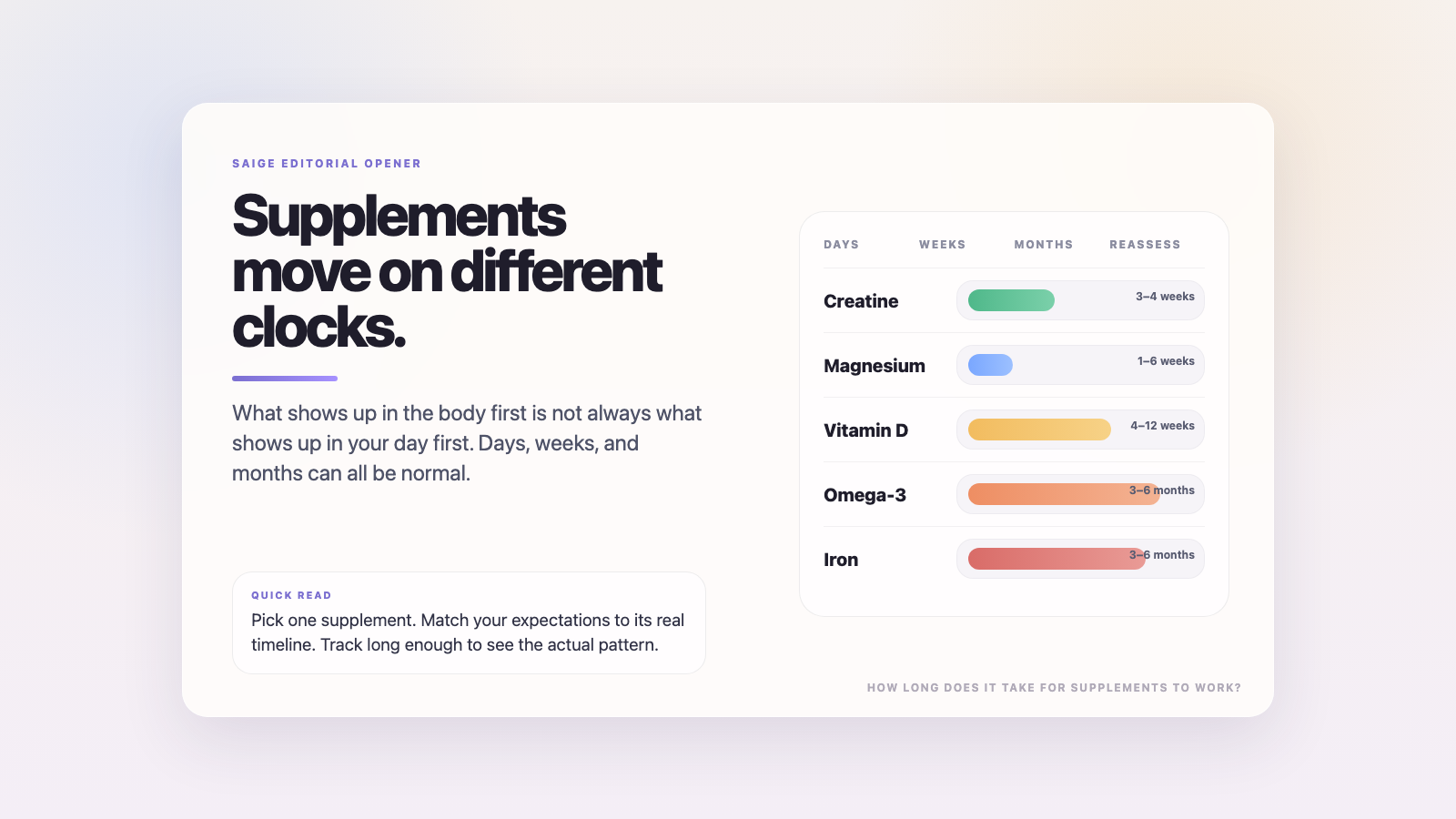 Most disappointment comes from mismatch: the supplement timeline is often longer than the expectation timeline.
You buy a supplement. Magnesium, vitamin D, whatever promised to help with sleep or energy or that vague feeling of being depleted. You take it for 10 days. Nothing. You stop.
Here's the part most people miss: you weren't tracking anything, so you have no idea if something actually changed.
The honest answer is: it depends on the supplement, the form, your baseline—and whether you're tracking at all. Some supplements show up in your bloodstream within days. Others need months to accumulate in your tissues. And some work on biology that you can't feel directly, so you need data to know they're working at all.
Why Timelines Are All Over the Place
This is actually kind of interesting. When researchers talk about supplement onset, they're measuring different things. A supplement might begin circulating in your blood within hours. That's straightforward biochemistry. But then there's tissue saturation, which is how long it takes for the supplement to build up in your cells to levels that actually trigger an effect. And there's symptom relief, which depends on your starting point.
Say you're deficient in vitamin D. You're not just filling a glass of water. You're filling a bathtub. If your baseline is very low, it takes longer to reach a level where you feel better. If you're already borderline adequate, supplementation might shift you into normal much faster.
The form matters too. Magnesium glycinate absorbs differently than magnesium oxide. Creatine monohydrate takes a different path than other creatine types. You can't just say "magnesium takes 2 weeks" without knowing which one.
And then there's you. Your age, your digestion, what else you're eating, whether you take it with food, how much you're absorbing—all of this changes the timeline.
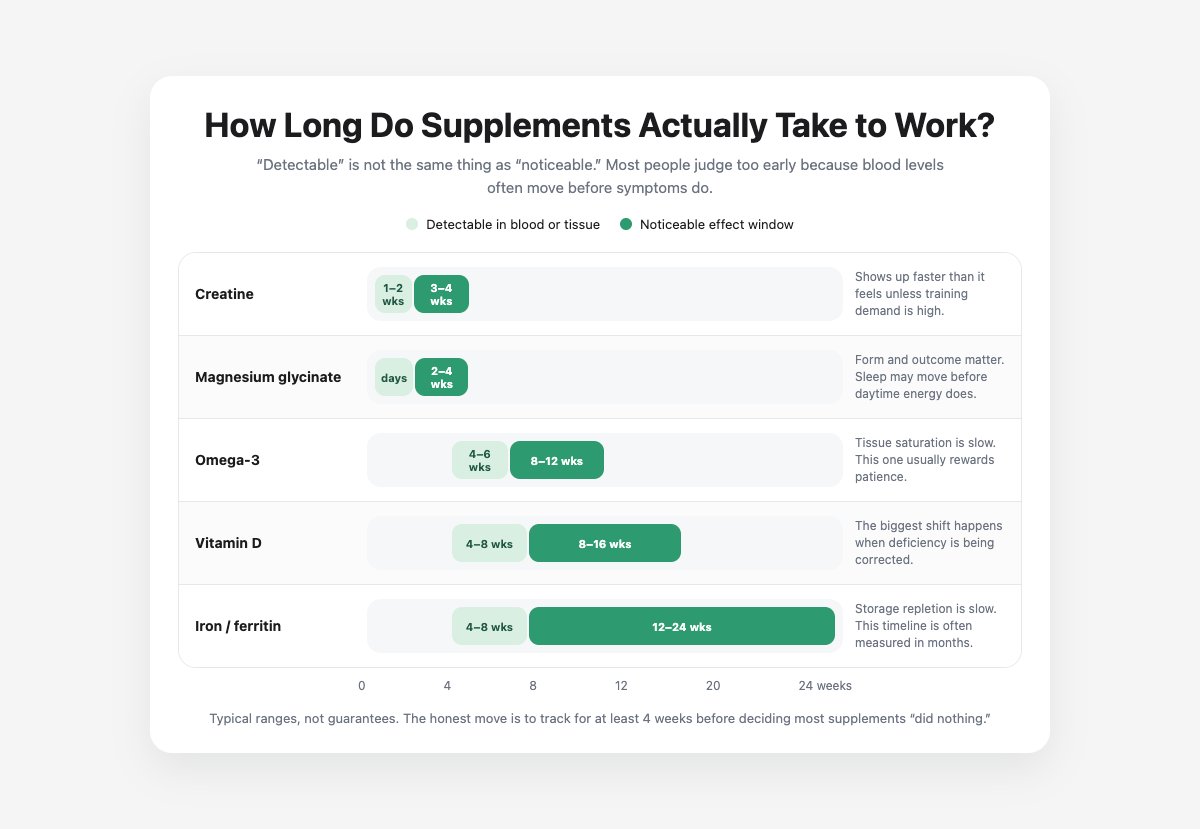
Ranges are approximate. Individual response varies based on baseline levels, form, and consistency.
What Actually Happens on Different Timelines
Here's what the research shows for the most common supplements:
Creatine monohydrate: If you load (take a higher dose for a few days), muscles reach saturation in about 5–7 days. If you go slow, it's more like 3–4 weeks at normal doses before you see the benefit. This one's interesting because the effect is measurable. It genuinely changes muscle energy production. But you'll only notice it during hard training. Week 2 might feel the same as week 1 in daily life.
Magnesium: Depends on the form and what you're hoping it does. For muscle relaxation, some people feel something within 24–48 hours, especially with glycinate. For sleep and mild anxiety, most research suggests 1–2 weeks of regular use before changes are noticeable. But for chronic conditions, plan on 4–6 weeks before deciding if it's actually working.
Vitamin D: Blood levels start rising within days (studies show median increases of about 3 ng/mL after a week), but feeling better or seeing actual benefits? Most people need 4–12 weeks. If you were severely deficient, it can take 3–6 months to fully correct the deficit and feel the impact.
Omega-3 (EPA and DHA): Tissue saturation is slow. You're looking at 4–6 months for red blood cells to fully incorporate EPA and DHA to meaningful levels. The research suggests 1,000–1,500 mg daily for at least 12 weeks before reassessing. This one requires patience.
Iron and ferritin: Hemoglobin increases after 2–4 weeks. But ferritin (your storage form) takes longer. Most people need 8–12 weeks just to see meaningful increases in circulating iron, then another 8–12 weeks to actually refill storage. The full picture is 3–6 months.
Why Tracking Changes Everything
Here's where most people fail: you start a supplement and rely on memory and feeling to decide if it's working.
Your brain is not reliable at this. You remember how you felt last month in broad strokes—tired, or anxious, or sluggish. When you feel good on day 14, your brain attributes it to the new supplement, not the fact that you slept well last night. When you feel bad on day 9, you assume the supplement isn't working, even if nothing was supposed to change yet.
Memory is actually worse than you think. Studies on subjective health changes show people consistently misremember their baseline. You think you were more fatigued than you actually were. You overestimate how often you had headaches. Your brain rewrites the past to match your current experience.
And intuition? Intuition tells you magnesium should work on day 3. It tells you vitamin D should kick in within a week. But biology doesn't care what your intuition says. Vitamin D needs 4–12 weeks. Creatine needs 3–4 weeks minimum. Knowing this intellectually and then expecting results on day 10 is just setting yourself up for disappointment.
This is where tracking changes everything. You need a baseline—before you start anything, you log how you actually feel right now. Sleep quality, energy at 2 PM, how often you feel anxious, workout recovery. Not every day (that's annoying and you won't stick with it), but often enough to see the real pattern.
Then you start the supplement. You keep tracking the same things. After 4–8 weeks, you look at baseline versus now. Did sleep quality actually improve, or did you just remember it as worse than it was? Did energy actually shift, or did one good day color your whole memory?
The people who figure this out are the ones with data. Not feelings. Not memory. Data.
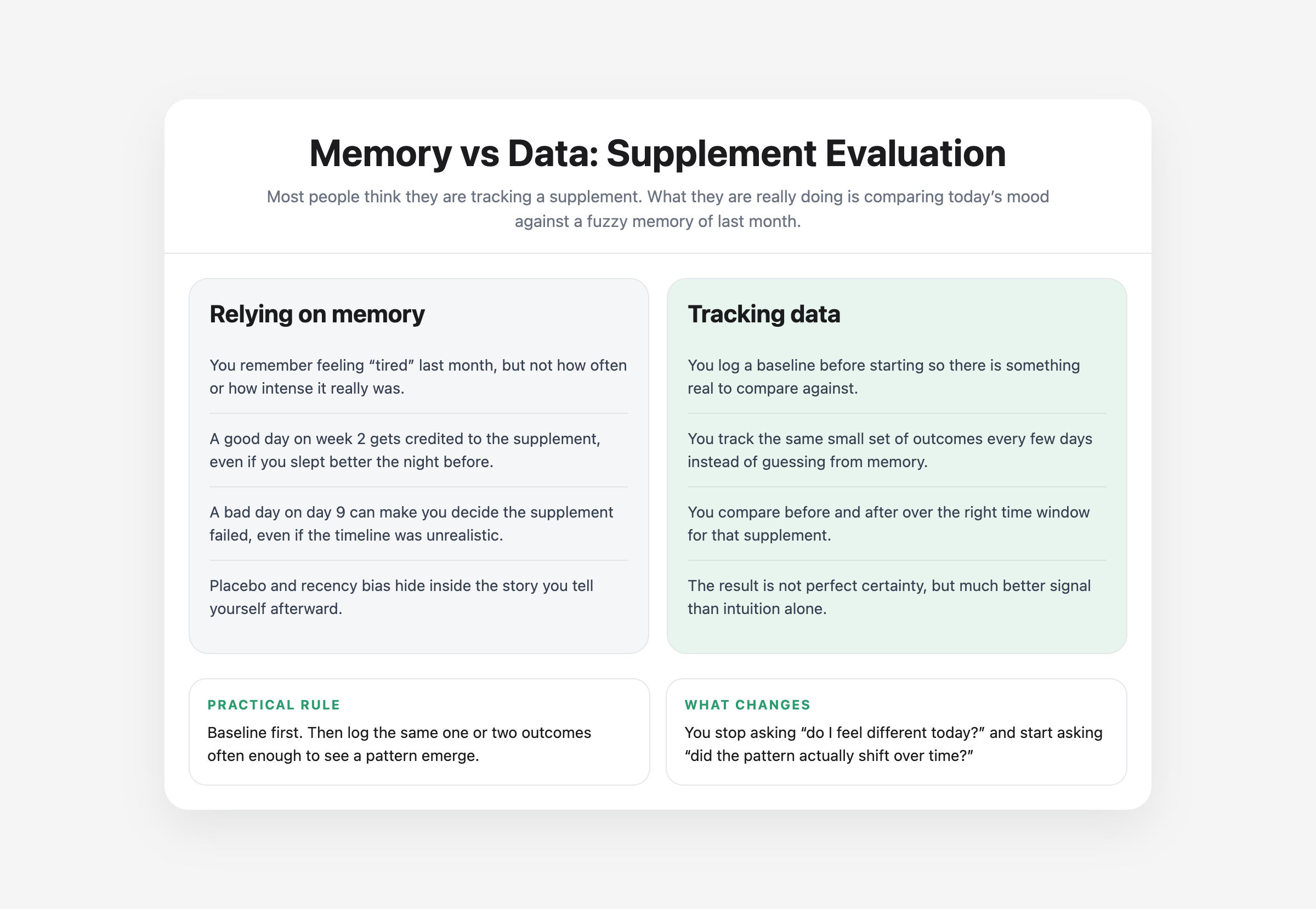 A simple baseline and a few repeated check-ins usually beat memory by a mile.
Log Your Baseline First
This is why logging before you start matters. If you want a simpler way to do that, Ovelia is built for exactly this kind of before-and-after comparison. The point is not more data. It is a cleaner read on whether the supplement actually changed anything.
Your baseline is your control group. You're running an experiment on yourself. Memory and feeling can't give you that. Data can.
Bottom Line
Supplements don't work on your schedule. Most need weeks or months to build up to levels that actually matter. And some, like vitamin D or iron, are correcting a deficit that took time to develop. Fixing it quickly isn't realistic.
Start tracking before you supplement. Note where you're at now—honestly, not how you wish you were. Then give it the actual timeline. Creatine? 3–4 weeks minimum. Magnesium? 4–6 weeks to be sure. Vitamin D? Push to 12 weeks before deciding. Omega-3? Go to 12 weeks.
How long do supplements take to work? As long as they need to. Your job is to observe what actually happens instead of guessing.
Sources:
Ready to track what actually works for you?
Ovelia turns what you read into a guided protocol you can actually follow.