 Ovelia.appAvailable on the App Store
Luteal Phase Fatigue: What's Actually Happening and What Helps
Luteal phase fatigue is not laziness, weak discipline, or proof that you suddenly forgot how to function for one week every month. The practical next step is to treat it like a repeating physiological pattern: track when it starts, how it overlaps with sleep, appetite, mood, and exercise tolerance, and support the cycle you actually have instead of arguing with it.
 When fatigue arrives on a schedule, the right question is not 'what is wrong with me?' It is 'what changes every month?'
Luteal phase fatigue is one of those symptoms women tend to explain away for years.
You tell yourself you are behind on sleep. Burned out. Slipping on routines. Bad at mornings. Bad at stress. Bad at life, basically.
Then it happens again. Same week. Same drag. Same sense that your body got heavier, your brain got slower, and normal tasks suddenly cost more.
That repeating pattern matters.
The luteal phase is the stretch after ovulation and before bleeding starts. Hormones do not simply "go up and down" here. Progesterone rises. Estradiol shifts. Temperature changes. Sleep quality can worsen. Appetite can change. Mood can get less stable. If you are sensitive to those predictable fluctuations, fatigue is a very normal place for that sensitivity to show up.
What the luteal phase actually does
The simplest version:
- ovulation happens
- progesterone rises
- basal body temperature tends to rise
- some women experience worse sleep, heavier perceived effort, more cravings, and lower resilience
It is not that luteal phase hormones are inherently bad. It is that some bodies are much more sensitive to the change.
A systematic review on biological rhythms in PMS and PMDD points in this direction: differences in melatonin, temperature regulation, and subjective sleep quality show up across the luteal phase in symptomatic women. Another review of PMS literature makes a related point: the problem does not seem to be that these women have wildly abnormal hormone levels, but that they respond differently to otherwise predictable hormonal shifts.
That is useful because it moves the conversation away from "my hormones are broken" and toward "my body is more reactive to this transition."
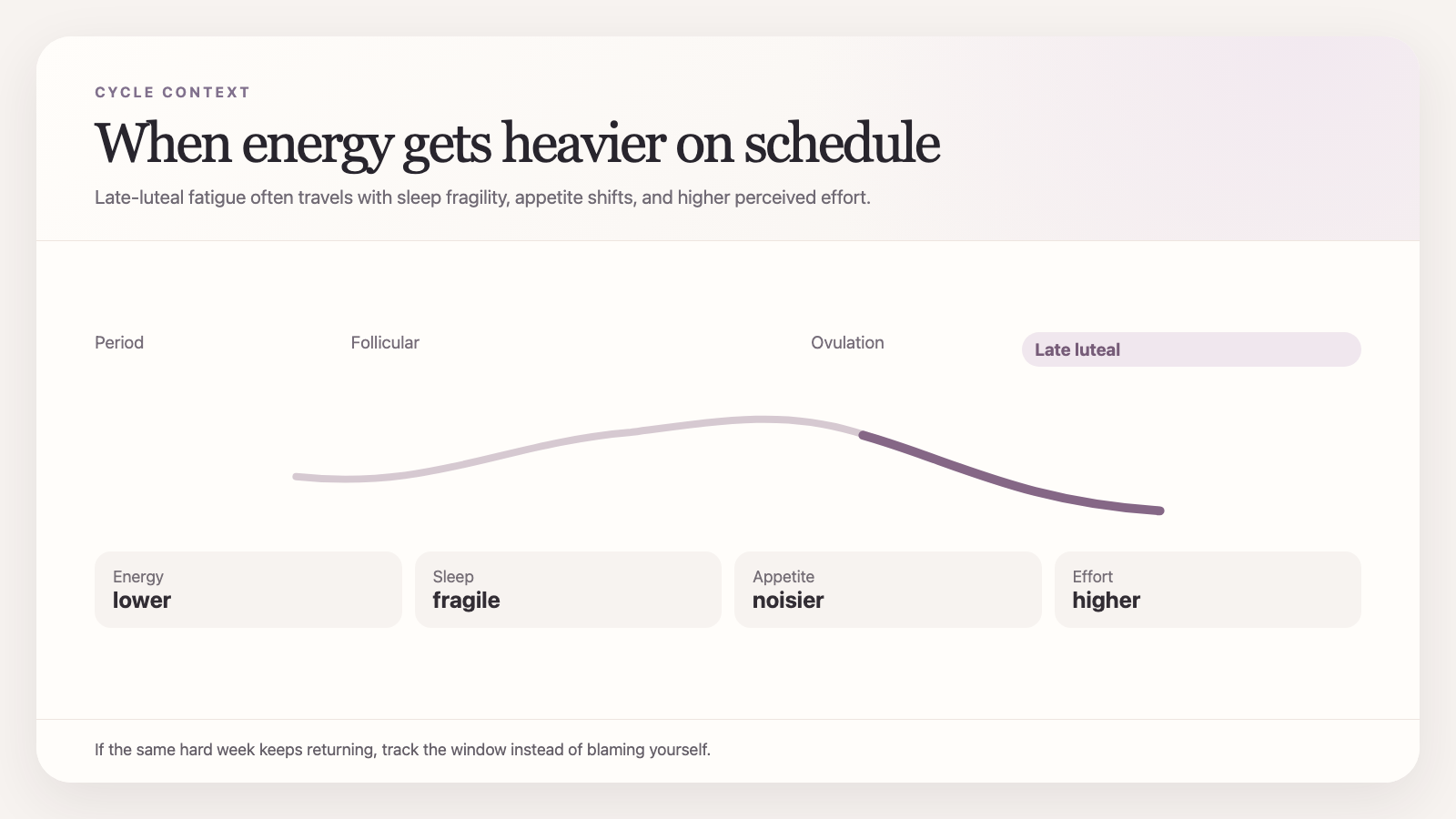 The late-luteal window can shift several inputs at once, making ordinary days feel more demanding.
Why it feels so physical
Luteal fatigue is not just "mood."
It can feel physical because several things change at once:
- Sleep quality often gets worse, even when total hours do not collapse.
- Core body temperature rises slightly, which can make sleep and training feel less easy.
- Appetite and blood sugar management can feel noisier.
- Perceived exertion can go up, so normal workouts or workdays feel more expensive.
That is why a woman can technically be doing the same things and still feel like she lost twenty percent of her capacity.
It is not imagined. It is patterned.
What helps first: naming the pattern
The first useful move is boring and powerful: stop treating the fatigue as random.
Ask:
- What cycle day does it usually start?
- How many days does it last?
- Does it show up with worse sleep?
- Do cravings, irritability, anxiety, or breast tenderness rise at the same time?
- Does training feel harder in the same window?
If the answer is yes, you are already doing better than the usual "I guess I am broken this week" framework.
The support plan that usually makes the most sense
Luteal fatigue usually responds best to support in four lanes:
1. Protect sleep aggressively
Because sleep often gets more fragile in this phase, small mistakes land harder.
That means:
- tighter caffeine cutoff
- more consistent bedtime
- cooler sleep environment
- less late light and late work spillover
This is not glamorous advice. It is just better than pretending the late-luteal week should tolerate the same abuse as a high-energy follicular week.
2. Stabilize food instead of chasing cravings with chaos
For many women, the luteal phase comes with a bigger appetite and less stable energy. That usually goes better with:
- more protein at meals
- fewer long gaps without food
- carbs paired with protein or fat rather than naked sugar hits
You do not need a punitive diet. You need fewer blood-sugar rollercoasters when your body is already less forgiving.
3. Lower the performance demand a little
Some women can train hard throughout the cycle without noticing much difference. Some cannot. That is not a character issue.
If your workouts consistently feel worse late-luteal, it may make more sense to:
- keep intensity but trim volume
- bias toward recovery and technique
- respect the week rather than trying to dominate it
4. Consider targeted symptom support
This is where supplements come in, but they should serve the pattern instead of replacing it.
Depending on the rest of the symptom picture, women commonly experiment with:
- magnesium for tension and sleep quality
- calcium when PMS symptoms overall are a big part of the picture
- targeted iron evaluation if fatigue feels broader and ferritin has never been checked
Not every luteal problem is a supplement problem. But some are worth testing.
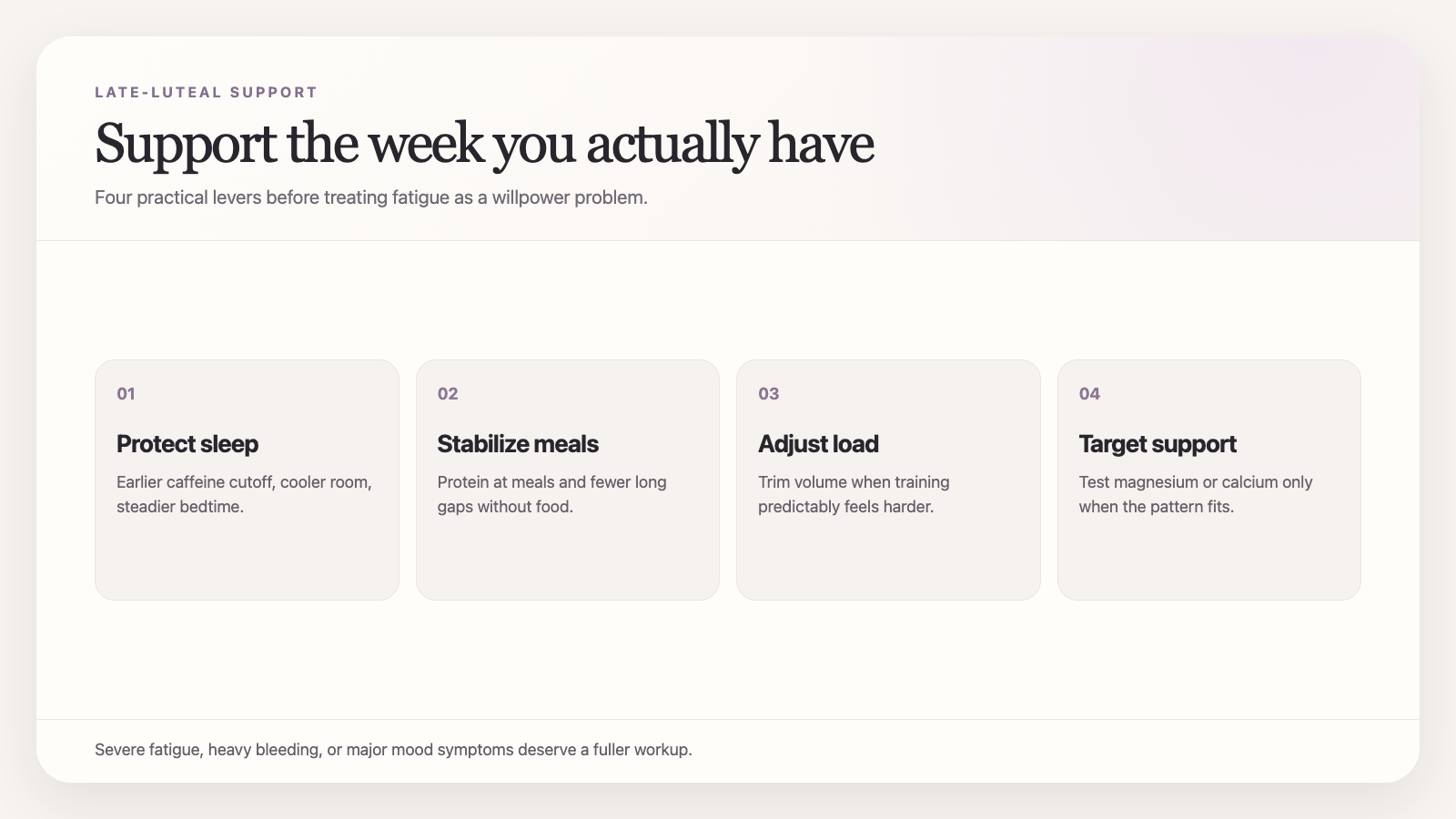 Support the predictable hard window with a small set of levers you can actually compare month to month.
When it stops being "just luteal fatigue"
This deserves a little bluntness.
If the fatigue is severe, cycle-disrupting, or paired with heavy bleeding, major mood symptoms, faintness, or symptoms that extend well beyond the late-luteal window, stop calling it a normal phase issue and get a fuller workup.
Ferritin, thyroid issues, sleep disorders, depression, medication effects, and perimenopausal change all love to masquerade as "cycle stuff."
Pattern recognition should make you smarter, not dismissive.
What to track
Track:
- cycle day
- fatigue severity
- sleep quality
- appetite or cravings
- workout tolerance
- mood
That is enough to turn a vague complaint into a readable pattern.
Ovelia is useful here because luteal fatigue is exactly the sort of symptom people misremember. You do not need a giant dashboard. You need a cleaner before-and-after view across repeating weeks.
The bottom line
Luteal phase fatigue is real, common, and easy to mislabel as a personal failure.
What is usually happening is simpler: your body is reacting to the late-cycle shift in a way that changes sleep, effort, and energy availability.
Track when it hits. Support sleep harder. Eat in a way that reduces volatility. Adjust demands if your body clearly wants that.
Then decide what actually helps, instead of having the same miserable week every month and acting surprised each time.
Sources:
Ready to track what actually works for you?
Ovelia turns what you read into a guided protocol you can actually follow.