 Ovelia.appAvailable on the App Store
Magnesium Glycinate vs. Oxide: Which Form Actually Works for Sleep
If you're trying magnesium for sleep, skip oxide and start with glycinate or bisglycinate instead. The evidence suggests a modest but real benefit when it's taken consistently for about 4 weeks, so the practical move is to use 200 to 400 mg elemental magnesium before bed and track sleep onset, overnight waking, and next-day recovery instead of judging it from one night.
 Sometimes the problem is not magnesium. It is the wrong form, the wrong expectations, or both.
If you've ever taken magnesium and felt... nothing — there's a good chance it was oxide.
Not because magnesium doesn't work. Because oxide, the form that dominates pharmacy shelves, is poorly absorbed. And "poorly absorbed" is doing a lot of work in that sentence. Research puts it around 4%. You take a capsule with 400mg of elemental magnesium on the label, and roughly 16mg makes it into your bloodstream. The rest acts as an osmotic laxative — drawing water into the colon and exiting the body without ever reaching the systems that might actually help you sleep.
This is the part most people miss. They try magnesium, it doesn't seem to do much, and they conclude magnesium isn't for them. When the real story is that the form was wrong.
Some nights it works. Some nights it doesn't.
Here's the pattern a lot of people describe: they start a magnesium supplement, have a few good nights, and then the effect seems to fade or become inconsistent. Some nights you fall asleep faster. The next night, nothing seems different. You can't tell if the supplement is doing anything, or if something else changed.
This is actually expected — and understanding why makes it a lot easier to evaluate whether magnesium is working for you. The effects are gradual, modest, and easy to misattribute. That's not a knock on magnesium. It's just what nutritional interventions look like. The signal is real but it doesn't announce itself.
Why magnesium and sleep are connected
Magnesium is involved in over 300 enzymatic reactions in the body, including several that directly regulate sleep. It activates the parasympathetic nervous system — the "rest and digest" state — and helps regulate GABA receptors, which are the same receptors targeted by many prescription sleep medications. It's also involved in melatonin production and helps control body temperature, which needs to drop for sleep to initiate.
When magnesium levels are low, these systems run noisier. The nervous system stays more activated, sleep onset takes longer, and sleep architecture — the cycling between light, deep, and REM sleep — can fragment.
Roughly half of adults in the US and Europe don't meet the recommended dietary intake for magnesium through food alone. That's a meaningful chunk of people experiencing poor sleep who may have a contributing factor they've never addressed — and who've probably already tried oxide and moved on.
What the research actually shows
A 2024 randomized, double-blind, placebo-controlled trial conducted at Leibniz University Hannover enrolled 155 adults aged 18–65 who self-reported poor sleep quality. Participants took 250mg of elemental magnesium daily as magnesium bisglycinate (same compound as glycinate — the names are interchangeable), plus 1,523mg of glycine, taken 30–60 minutes before bed for 28 days.
The primary endpoint was the Insomnia Severity Index (ISI), a validated questionnaire measuring how significantly sleep problems affect daily functioning.
Here's what they found: the magnesium bisglycinate group showed a mean ISI score reduction of 3.9 points from baseline, compared to 2.3 points in the placebo group. Statistically significant (p = 0.049). Within the bisglycinate group, ISI scores fell 28% from baseline to day 28, versus 18% in the placebo group.
The effect size was small (Cohen's d = 0.2), and the researchers used the word "modest" deliberately. This is worth being honest about: magnesium bisglycinate is not a sleep medication. It doesn't work the same night and it doesn't produce dramatic results in everyone. About 19% of participants in the bisglycinate group showed a clinically meaningful improvement (defined as a 6-point or greater ISI reduction), compared to 11% in the placebo group.
That's a real difference — nearly twice as many people achieved meaningful improvement. But it also means most people in both groups saw smaller changes. That's pretty typical with supplements: the effect can be real without being dramatic.
The researchers concluded that magnesium bisglycinate represents "a potential non-pharmacological option for mild insomnia." That's about as strong as the data supports.
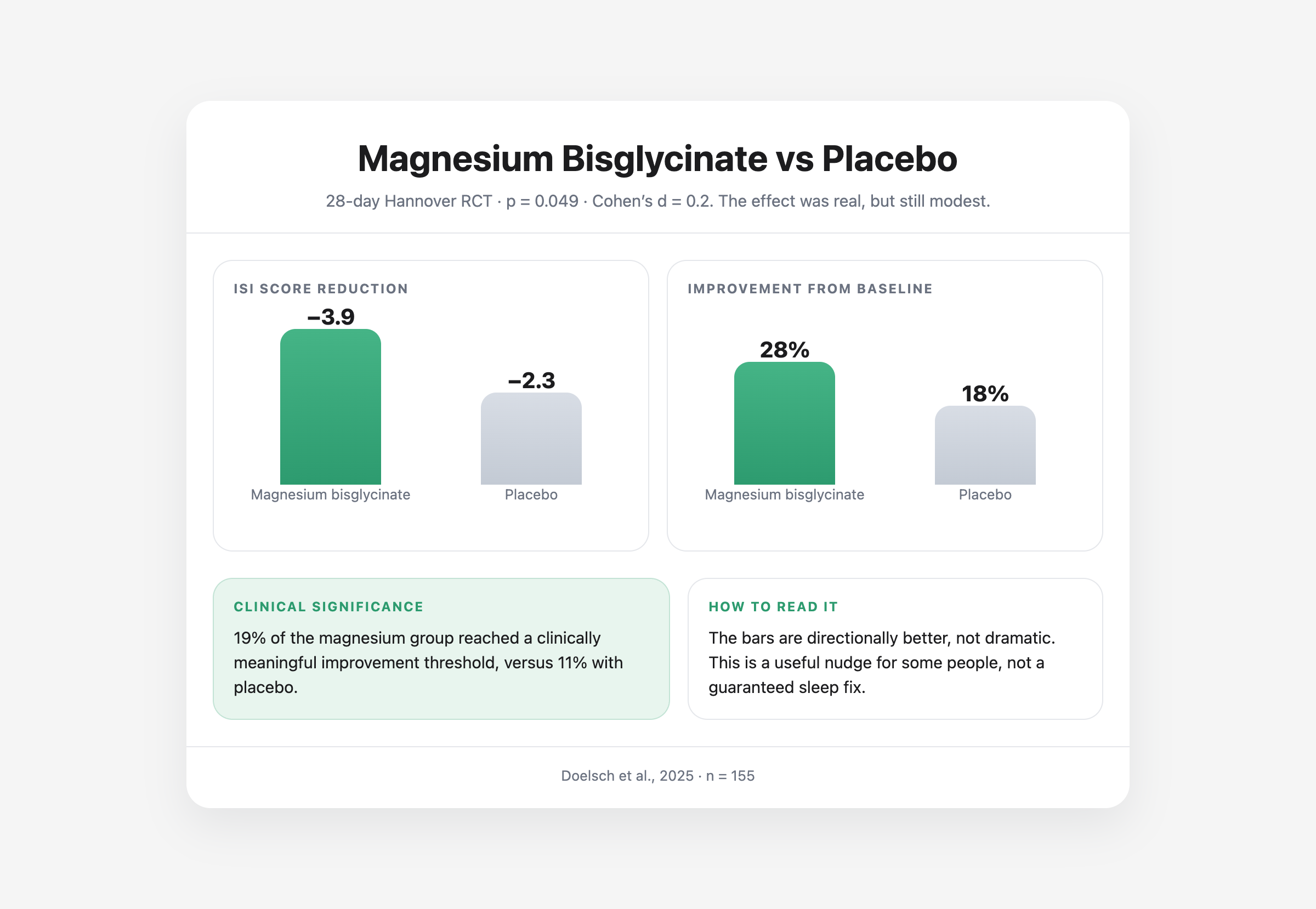 Results from the 2025 Hannover RCT (n=155, 28 days). Effect size was modest (Cohen's d = 0.2).
Why form matters so much
The reason glycinate outperforms oxide isn't just a label claim about absorption. The two forms behave differently in the gut.
Magnesium oxide is an inorganic salt with poor water solubility. It doesn't dissolve well in the gut, so it remains largely intact rather than releasing magnesium ions that can cross the intestinal wall. The fraction that does dissolve enters via standard mineral transport pathways that have upper limits.
Magnesium glycinate is a chelate: the magnesium ion is bound to two molecules of the amino acid glycine. That pairing appears to help it absorb more efficiently and avoid some of the bottlenecks that limit inorganic forms like oxide. In practice, glycinate tends to absorb several times better than oxide.
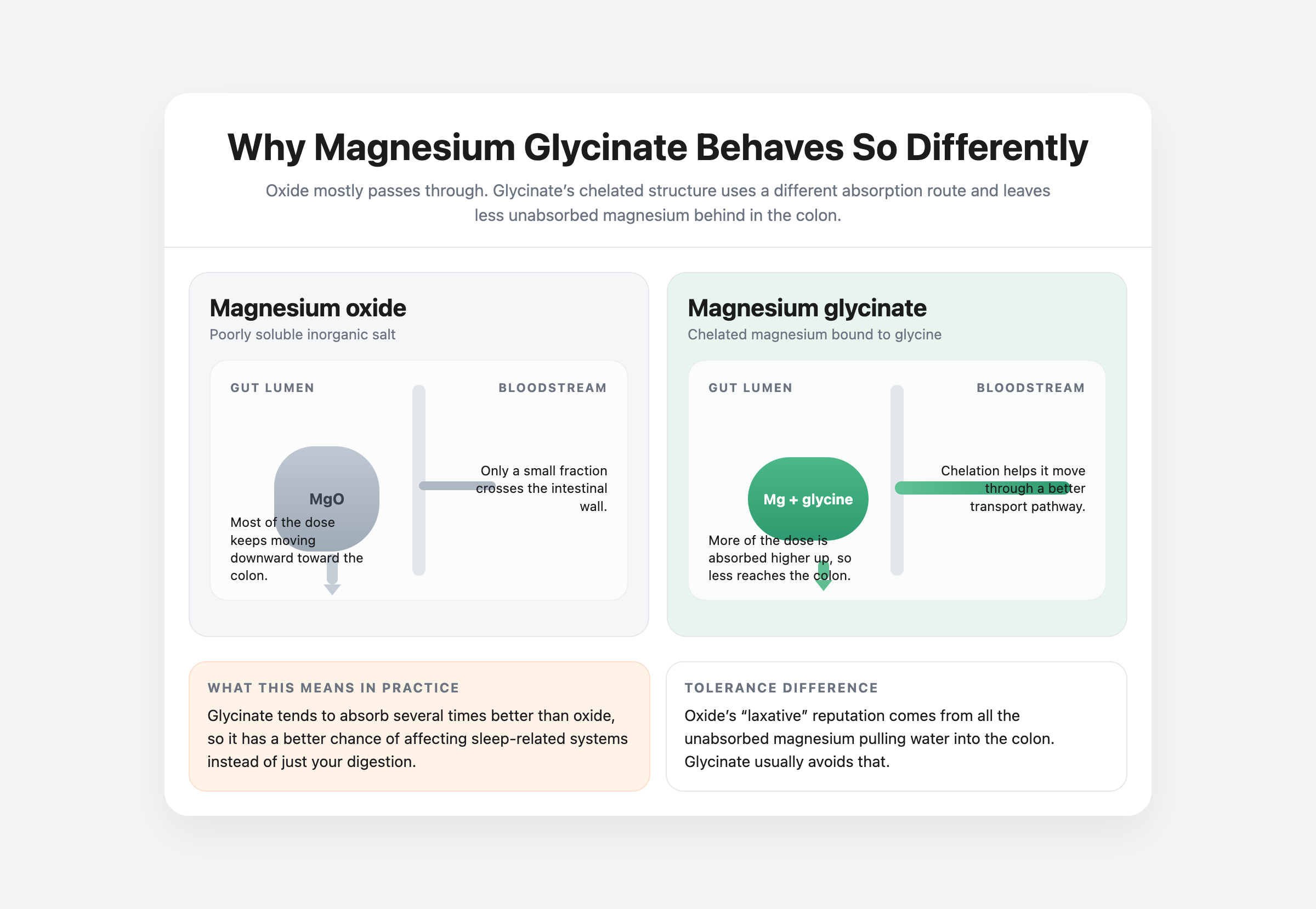 Glycinate tends to clear the gut bottleneck more cleanly than oxide, which helps both absorption and tolerance.
This is also why glycinate is better tolerated. Because more of it absorbs higher in the digestive tract, less unabsorbed magnesium reaches the colon to draw in water. The laxative effect that makes oxide a reliable constipation remedy is largely absent with glycinate — which matters if you're taking it nightly.
Magnesium threonate, worth a brief mention, uses a different mechanism: the threonate molecule is specifically designed to cross the blood-brain barrier, making it more relevant for cognitive applications than sleep quality per se. If sleep is the goal, glycinate is the better-studied choice.
What to actually take, and when
The Hannover trial used 250mg of elemental magnesium as bisglycinate, taken 30–60 minutes before bed. This is consistent with most research on magnesium for sleep and is a reasonable starting point.
Dosing context: the recommended dietary allowance for magnesium is 310–320mg/day for women and 400–420mg/day for men. If you're getting meaningful amounts through food — leafy greens, nuts, seeds, dark chocolate — you may need less supplemental magnesium. If your diet is lower in those foods, 200–400mg of magnesium glycinate in the evening is a sensible range to try.
Take it with or without food — unlike fat-soluble vitamins, magnesium glycinate doesn't require dietary fat for absorption. And consistency matters more than the exact dose. Both groups in the Hannover trial showed progressive improvement across the 28 days, which suggests the effects accumulate rather than appearing immediately.
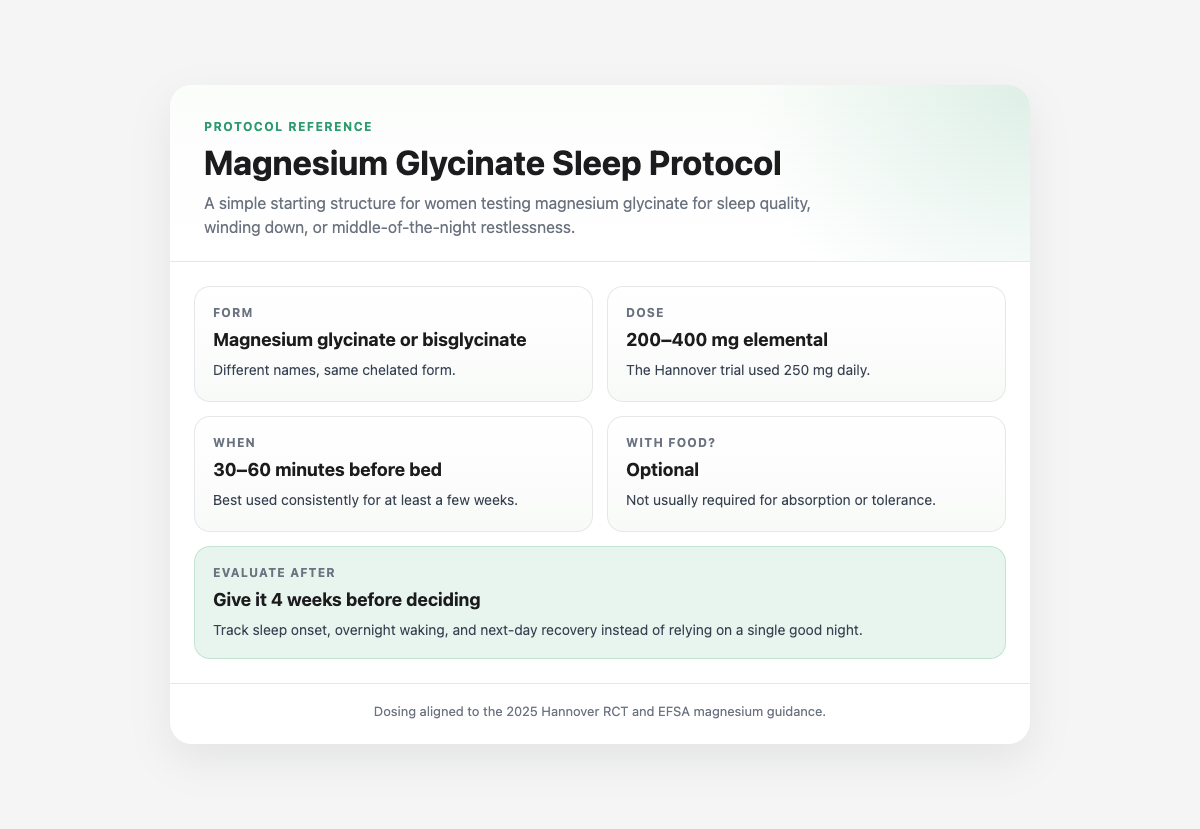 Dosing based on the 2025 Hannover RCT and EFSA magnesium guidelines.
What to track — and why you can't rely on memory
Most people can't tell if magnesium is working because the changes are subtle and inconsistent. One night you fall asleep faster. The next night you don't. Your memory smooths it out or exaggerates it depending on how you slept last night.
Without tracking, it's almost impossible to know what's actually changing — and that's not a personal failing, it's just how the brain handles gradual, variable signals. You'll either conclude it's definitely working (confirmation bias) or that it did nothing (recency bias on a bad night). Neither tells you anything real.
The people who actually figure out whether magnesium is helping them track it. Start with a baseline week, then do consistent check-ins for four weeks: sleep onset time, overnight wake-ups, morning feel. Four weeks is what the research used, and it's usually long enough to tell whether anything is actually changing.
If you want a simpler way to do that without relying on notes and memory, Ovelia can help you keep the supplement, timing, and sleep check-ins in one place. That's where the signal is — not in how you feel on any given morning.
The bottom line
If sleep is the goal, glycinate is the better bet. It absorbs better, it's easier on the stomach, and it's the form used in the best sleep study we have. The evidence points to a modest but real improvement in insomnia severity when it's taken consistently at 250mg of elemental magnesium before bed for at least four weeks.
It's still not a dramatic intervention. But it is a low-risk, evidence-grounded one, and the form you choose makes a big difference between something you can fairly evaluate and something that mostly passes through you.
Sources:
- Doelsch M, et al. Magnesium Bisglycinate Supplementation in Healthy Adults Reporting Poor Sleep: A Randomized, Placebo-Controlled Trial. Nature and Science of Sleep. 2025. PMC12412596
- Schuchardt JP, Hahn A. Intestinal Absorption and Factors Influencing Bioavailability of Magnesium — An Update. Current Nutrition and Food Science. 2017. PMC6683096
Ready to track what actually works for you?
Ovelia turns what you read into a guided protocol you can actually follow.