 Ovelia.appAvailable on the App Store
Omega-3 Forms Compared: Fish Oil, Krill, and Algae
Omega-3 form changes how much EPA and DHA you actually absorb, which means the same dose can perform very differently depending on what you buy. The practical move is to choose rTG fish oil for value, krill for maximum absorption, or algae if you need a plant-based option, then take it with a fat-containing meal and reassess after at least 8 to 12 weeks.
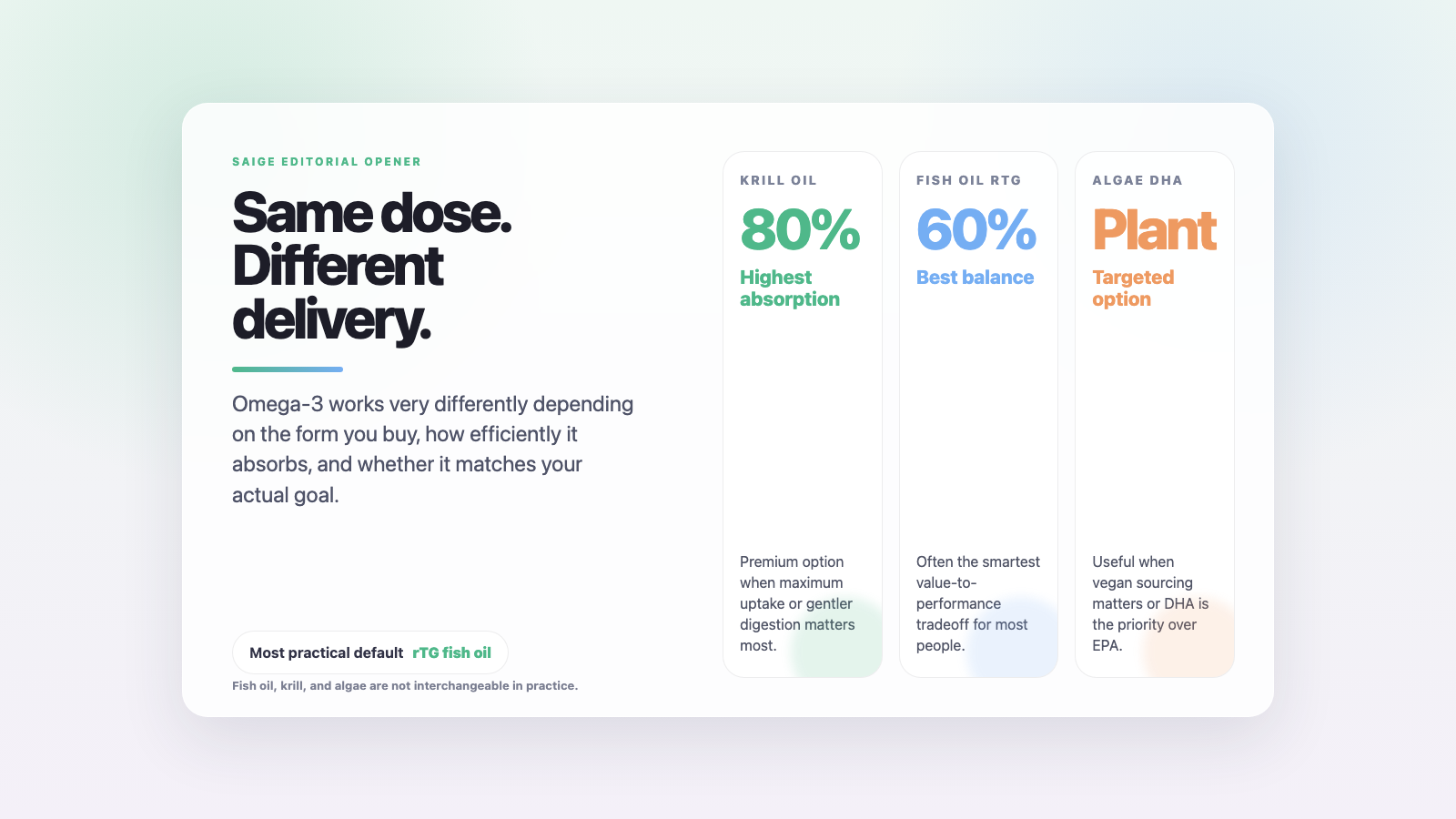 With omega-3, the label amount is only half the story. The delivery system changes what actually gets through.
Not all omega-3 supplements are equally absorbed. That's not marketing spin. It's basic biochemistry with real consequences for how long it takes to see results.
You can take 2 grams of omega-3 every day for three months and see nothing. Or take a different form of the same 2 grams and feel clearer, calmer, more focused within 6–8 weeks. The supplement didn't change. Your absorption did.
This matters because mood, energy, and cognitive effects from omega-3 take time. Six to eight weeks is the realistic timeline if the form you're taking actually gets into your bloodstream. If you pick the wrong form, you might be waiting twice as long, or not seeing the effect at all.
How Form Changes Everything
Fish oil exists in three main chemical forms: ethyl ester (EE), re-esterified triglyceride (rTAG), and natural triglyceride (TAG). Krill oil is mostly phospholipid. Algae-based omega-3 is typically DHA in triglyceride form.
The gut doesn't absorb all of these equally.
A comparative bioavailability study (the gold standard for testing absorption) measured how much EPA and DHA actually made it into the bloodstream after a single dose of each form. Here's what they found:
Krill oil (phospholipid form) had the highest incorporation: 80% of the EPA+DHA dose showed up in plasma phospholipids.
Fish oil rTAG came next: 60% incorporation.
Fish oil ethyl ester (EE) came last: 48% incorporation.
That's not a small difference. Krill oil gets about 67% more EPA+DHA into your blood compared to ethyl ester fish oil, from the same total dose.
The study also found high individual variation though. Some people absorb ethyl ester well enough. Others don't. You might be an outlier either way.
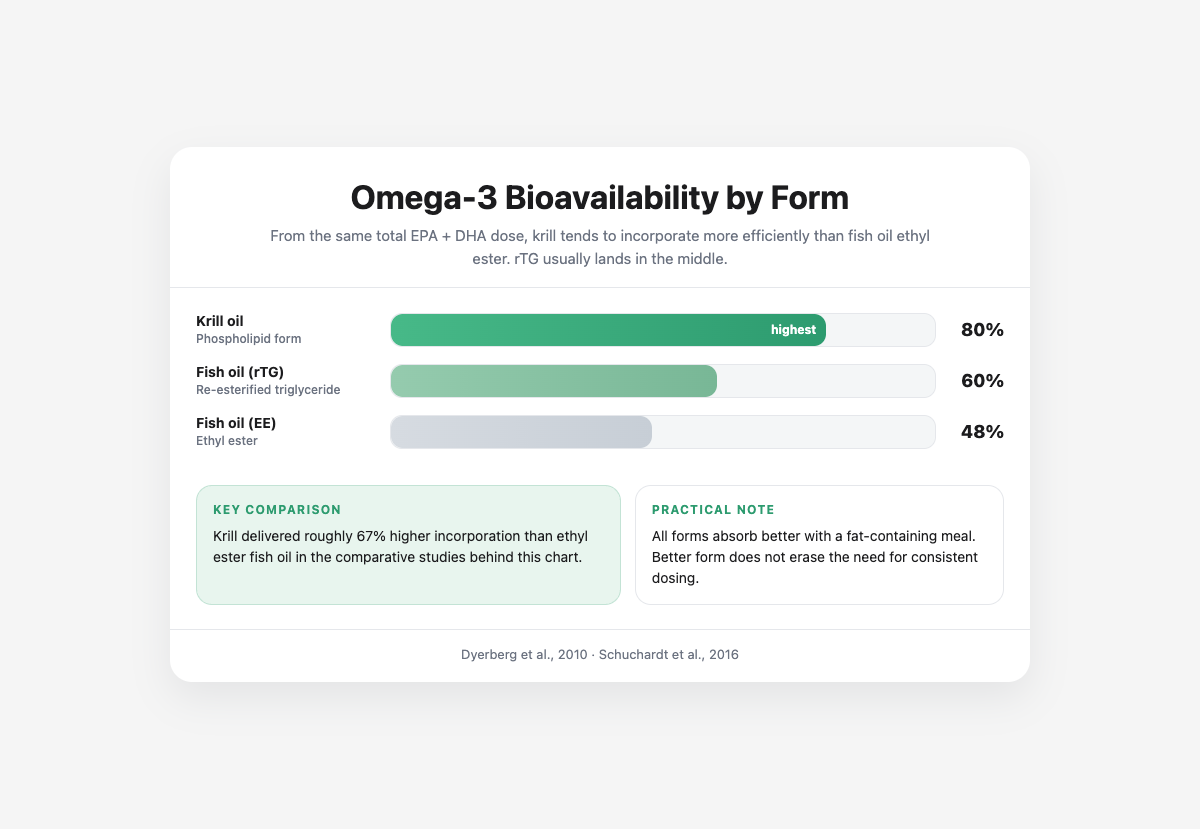
Dyerberg et al., 2010; Schuchardt et al., 2016. Take all forms with a fat-containing meal.
EPA and DHA: Different Jobs
Before diving into forms, it helps to understand that EPA and DHA aren't interchangeable.
EPA (eicosapentaenoic acid) is the anti-inflammatory workhorse. It's the form most directly linked to mood improvements, inflammation reduction, and cardiovascular benefits. If you're supplementing primarily for mood or depression, EPA is the one that matters more.
DHA (docosahexaenoic acid) is structural. It builds cell membranes, especially in the brain. It's crucial for cognitive function and long-term brain health. It doesn't directly fight inflammation the way EPA does, but it's where the cellular changes happen.
Most omega-3 supplements have both, but in different ratios. Fish oil is often higher in EPA. Krill is balanced. Algae supplements are typically pure DHA. The ratio matters for what you're trying to accomplish.
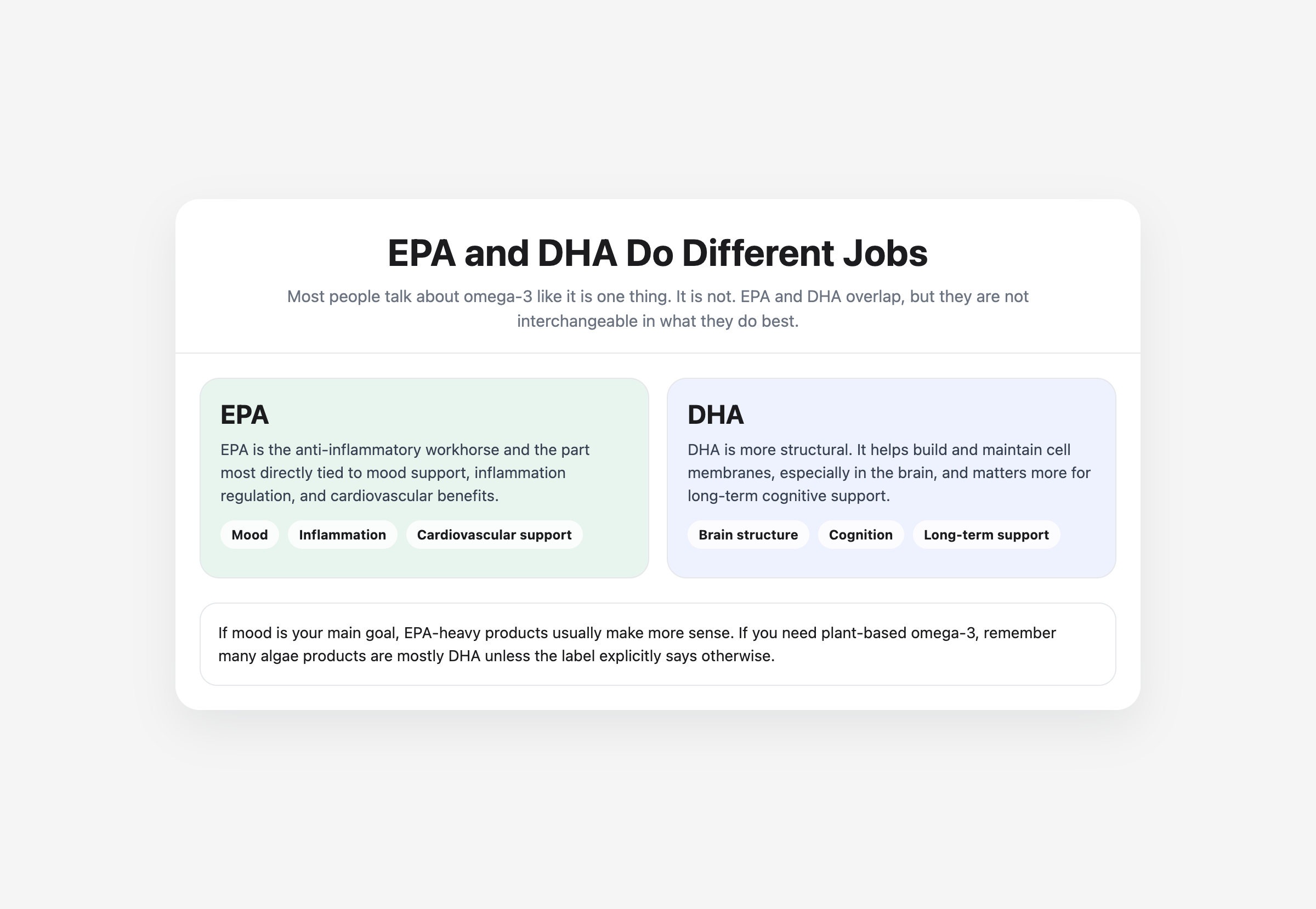 EPA and DHA are partners, but not duplicates. The ratio changes what the supplement is best suited for.
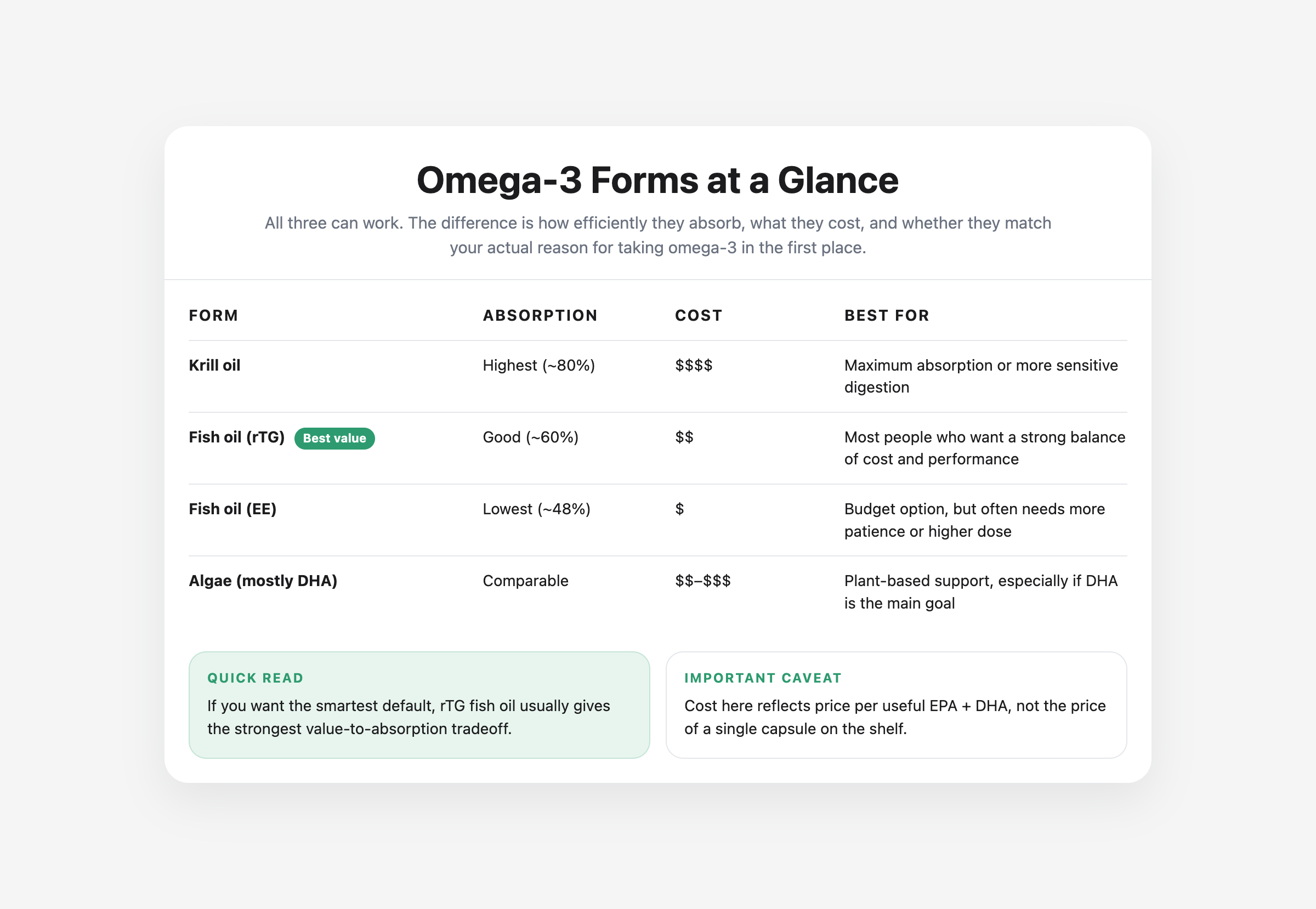 Form determines both absorption and value. The cheapest label is not always the cheapest effective dose.
Fish Oil: The Form Matters More Than You Know
Fish oil is cheap and widely available, but quality varies wildly by chemical form.
Ethyl ester fish oil (EE) is common because it's inexpensive to produce. But it's also the least bioavailable form. Your stomach acid and pancreatic enzymes have to work harder to break it down. Some studies show bioavailability around 40–50% compared to the natural form. If you're taking a standard fish oil gel cap from a grocery store, there's a reasonable chance it's an ethyl ester. You might need twice as much to get the same effect as the re-esterified form.
Re-esterified fish oil (rTAG) is chemically restructured to match the form fish naturally contain. Bioavailability is about 30% higher than ethyl ester, and about 10% higher per gram than natural fish oil TAG, possibly because the processing standardizes the form.
Natural triglyceride fish oil (TAG) is absorbed reasonably well, but it's variable—different fish, different batches, different processing. Re-esterified versions control for this variability.
If you're already taking fish oil, check the label. If it says "ethyl ester" or just "fish oil" without specification, you might be absorbing 40–50% of what you think you are.
Krill Oil: Better Absorption, Higher Cost
Krill are tiny crustaceans. Krill oil is structured differently than fish oil. The omega-3 fatty acids are bound to phospholipids rather than triglycerides. Phospholipids have both water-loving and fat-loving parts (that's what amphiphilic means), so they emulsify better in your digestive tract and integrate into cell membranes more easily.
The absorption study showed krill delivering the highest blood levels of EPA+DHA. But the cost per gram of EPA+DHA is typically 3–5 times higher than fish oil. You're paying for better absorption, not more total omega-3.
For most people trying to reach an effective dose (1–2 grams EPA+DHA daily), the cost difference means fish oil rTAG is usually the better value. You get absorbed well enough, and you spend less. For someone who has a sensitive stomach or who's had absorption issues with fish oil, krill's superior absorption might justify the premium.
One caveat: the study that compared forms also found krill oil contained about 22% of its EPA as free EPA (not bound to anything)—an unexpected finding that might improve absorption further, though this wasn't true of the fish oil samples tested.
Algae: The Plant-Based Option
Algae-based omega-3 supplements come almost entirely as DHA, not EPA. That's a functional difference: you're getting brain-building DHA but not the anti-inflammatory EPA. If mood is your primary goal, algae alone probably isn't your best choice. If you're vegan or vegetarian and need omega-3, algae DHA is better than nothing—and it's actually where fish get their DHA from originally (they eat algae, concentrate it, and we eat the fish). Bioavailability is comparable to fish oil, though usually without the EPA.
Some newer products combine algae DHA with algae-derived EPA, but these are less common and more expensive. If you want both EPA and DHA from plant sources, check the label carefully—many algae supplements are DHA-only.
Timing and Real Absorption
How you take omega-3 matters almost as much as which form.
Omega-3 is fat-soluble. It absorbs best with a meal containing fat. Taking a fish oil capsule on an empty stomach or with a fat-free breakfast reduces absorption. Take it with lunch or dinner that includes protein and fat (nuts, olive oil, meat, dairy). This isn't minor. Some research shows fat with the meal can increase absorption by 30–50%.
Consistency also matters. Omega-3 doesn't build up overnight. You're looking at 6–8 weeks minimum before mood or energy changes become noticeable. This is why some people say "fish oil doesn't work." They took it for two weeks, felt nothing, and stopped. Not unreasonable. Just an incomplete timeline.
What to Track When You're Starting
Because individual absorption varies, the smartest approach is to track and observe.
Pick a form (fish oil rTAG if cost matters, krill if you want maximum absorption, algae if you need vegan). Dose consistently—aim for 1–2 grams total EPA+DHA daily, with a meal containing fat, taken at the same time. Note the date you start.
Over the next 6–8 weeks, track:
- Mood: simple 1–10 scale or three categories (low, neutral, good)
- Energy: More stable or unchanged?
- Brain clarity: Foggy, normal, or sharp?
Log every few days. After 8 weeks, look at the data. Did your baseline shift? Are low-mood days becoming less frequent? Is your energy more stable? These are the effects people typically notice.
If you see a shift, you've found your form and your dose. If you see nothing, you might be in the 10–15% of people who don't respond to omega-3 supplementation, or you might absorb the form you chose poorly. In that case, switching to krill (better absorption) or re-esterified fish oil (better than ethyl ester) is worth trying for another 6–8 weeks.
The people who get results with omega-3 aren't the ones who guess about it. They're the ones who track.
The Takeaway
Omega-3 form is not trivial. Fish oil ethyl ester and krill oil differ by about 67% in bioavailability. That's a real, measurable difference that translates to real time—one form might show you a mood effect in 6 weeks, another in 12. Or one might work for you and another won't.
The cheapest fish oil is probably ethyl ester and probably worth upgrading from if you've been taking it without results. Krill is genuinely better absorbed but costs more. Algae is a solid plant-based option if you're vegan, but it's DHA-only.
Take it with food containing fat. Wait 6–8 weeks. Track your actual experience. That's how you move past "I'm taking fish oil" to "fish oil is actually working for me."
Sources:
- Incorporation of EPA and DHA into plasma phospholipids in response to different omega-3 fatty acid formulations—a comparative bioavailability study of fish oil vs. krill oil. Schuchardt JP, Schneider I, Meyer H, Neubronner J, von Schacky C, Hahn A. Lipids in Health and Disease. 2011;10:145.
- Comparison of Omega-3 polyunsaturated fatty acids bioavailability in fish oil and krill oil: Network Meta-analyses. Current Medicinal Chemistry. 2024.
Ready to track what actually works for you?
Ovelia turns what you read into a guided protocol you can actually follow.