 Ovelia.appAvailable on the App Store
Different Protein Supplements Compared: Whey vs. Casein vs. Plant vs. Collagen
Protein powders are not interchangeable just because they all say '20 grams' on the label. If your goal is muscle and recovery, whey usually wins on convenience and leucine. If you want slower digestion, casein has a case. Plant blends can work well when formulated intelligently. Collagen belongs in a different lane.
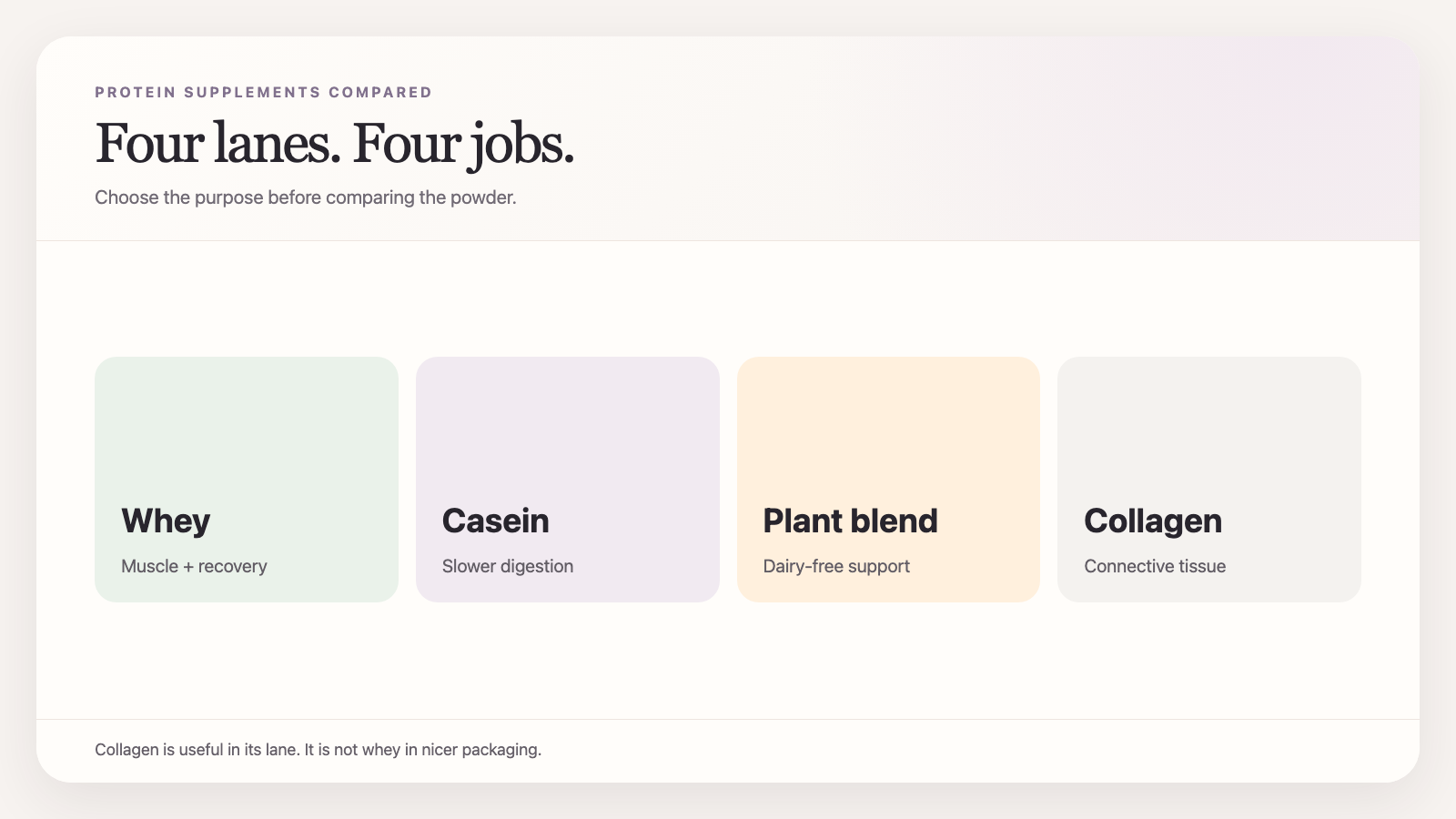 The label can say protein. The use case is still doing the real sorting.
Protein supplements are easy to overcomplicate and easy to oversimplify.
Oversimplified version: protein is protein, just hit the number.
Overcomplicated version: if you do not pick the perfect powder, your muscles, skin, satiety, and hormone balance will collapse by noon.
The truth is calmer.
These products are not identical. But you usually do not need a doctoral thesis to choose well. You just need to know what each one is best at.
Whey: the easiest default for muscle and recovery
Whey is the default recommendation for a reason.
It is rapidly digested, rich in essential amino acids, and especially high in leucine, the amino acid most associated with triggering muscle protein synthesis. Review literature has repeatedly found whey to be one of the more effective supplemental proteins for supporting muscle mass and recovery, especially around resistance training.
That does not mean whey is magic. It means it is efficient.
Best fit:
- post-workout convenience
- muscle and strength support
- high-protein breakfasts
- people who tolerate dairy well
If your goal is straightforward muscle support and you digest dairy fine, whey is still the boringly correct answer most of the time.
Casein: slower, steadier, better for some schedules
Casein is also a dairy protein, but it digests more slowly than whey.
That slower digestion can be useful when:
- you want a more sustained protein release
- you are trying to stay fuller longer
- you prefer a slower-acting evening protein option
The common shorthand is that whey is more "fast" and casein is more "slow." That is directionally true and still the most useful way to think about it.
Casein is not usually more exciting than whey for muscle protein synthesis in the immediate post-exercise window. It is just a different tool.
Plant protein: better than people think when the blend is good
Plant protein is where outdated advice lingers.
The older criticism was that plant proteins are lower quality, less digestible, and less effective for muscle support because some are lower in specific essential amino acids or leucine. That concern is not completely fake. It is just too blunt.
The more current review literature makes a better point: plant proteins can absolutely support muscle mass and muscle protein synthesis, especially when:
- total intake is adequate
- leucine threshold is addressed
- the product uses a thoughtful blend rather than a weak single source
There are now trials showing plant protein blends can stimulate postexercise myofibrillar protein synthesis equivalently to whey under the right conditions.
Best fit:
- dairy-free needs
- vegan or mostly plant-based eating
- people willing to choose a better-formulated blend rather than the cheapest tub on earth
If you go plant-based, quality matters more. A pea-rice blend is generally more convincing than treating collagen and vibes as a muscle strategy.
Collagen: useful, but not as a muscle replacement
This is the most misused product in the category.
Collagen is still protein, but it is not a complete protein in the way whey, casein, or well-formulated plant blends are. It is relatively low in key amino acids needed to drive muscle protein synthesis well, especially compared with whey.
That means collagen should not be your first-choice protein powder if your primary goal is:
- muscle gain
- strength
- workout recovery
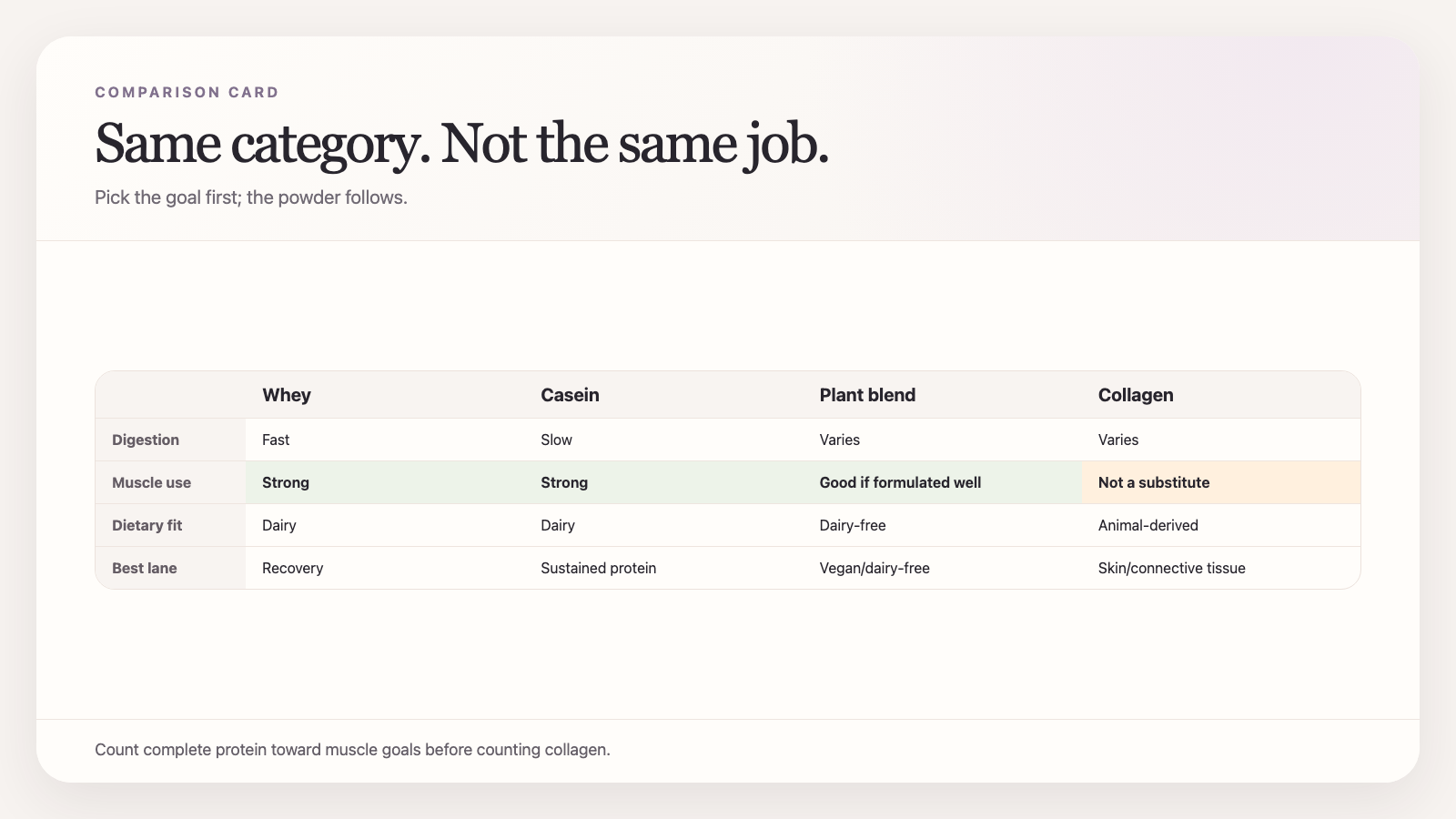 All four may sit on the protein shelf, but collagen is not a complete-protein substitute for muscle goals.
Where collagen does look more plausible is a different lane:
- skin hydration and elasticity
- possibly joint discomfort or connective-tissue-oriented support
The collagen literature is not perfectly clean either, but systematic reviews and umbrella reviews do suggest signal for skin hydration/elasticity and some musculoskeletal outcomes. That is a totally different claim from "collagen is just as good as whey for muscle." It is not.
What about satiety?
Protein in general helps with satiety. The evidence on whether one source dramatically outperforms another is less dramatic than marketing suggests.
Some studies suggest whey may suppress hunger more than casein or soy in certain settings, and there is at least one randomized trial in overweight women where whey outperformed collagen on some body-composition-related outcomes. But if you are expecting a completely different appetite life from one swap alone, lower your drama budget.
The bigger satiety question is usually:
- did you eat enough protein at all?
- did the meal have enough total food volume and structure?
The cleanest decision guide
If your goal is muscle and recovery:
- choose whey first
- or a strong plant blend if dairy-free
If your goal is slower digestion or a more sustained-feeling protein:
- casein makes sense
If your goal is skin or connective-tissue support:
- collagen can be reasonable
- just stop pretending it is the same thing as a muscle protein powder
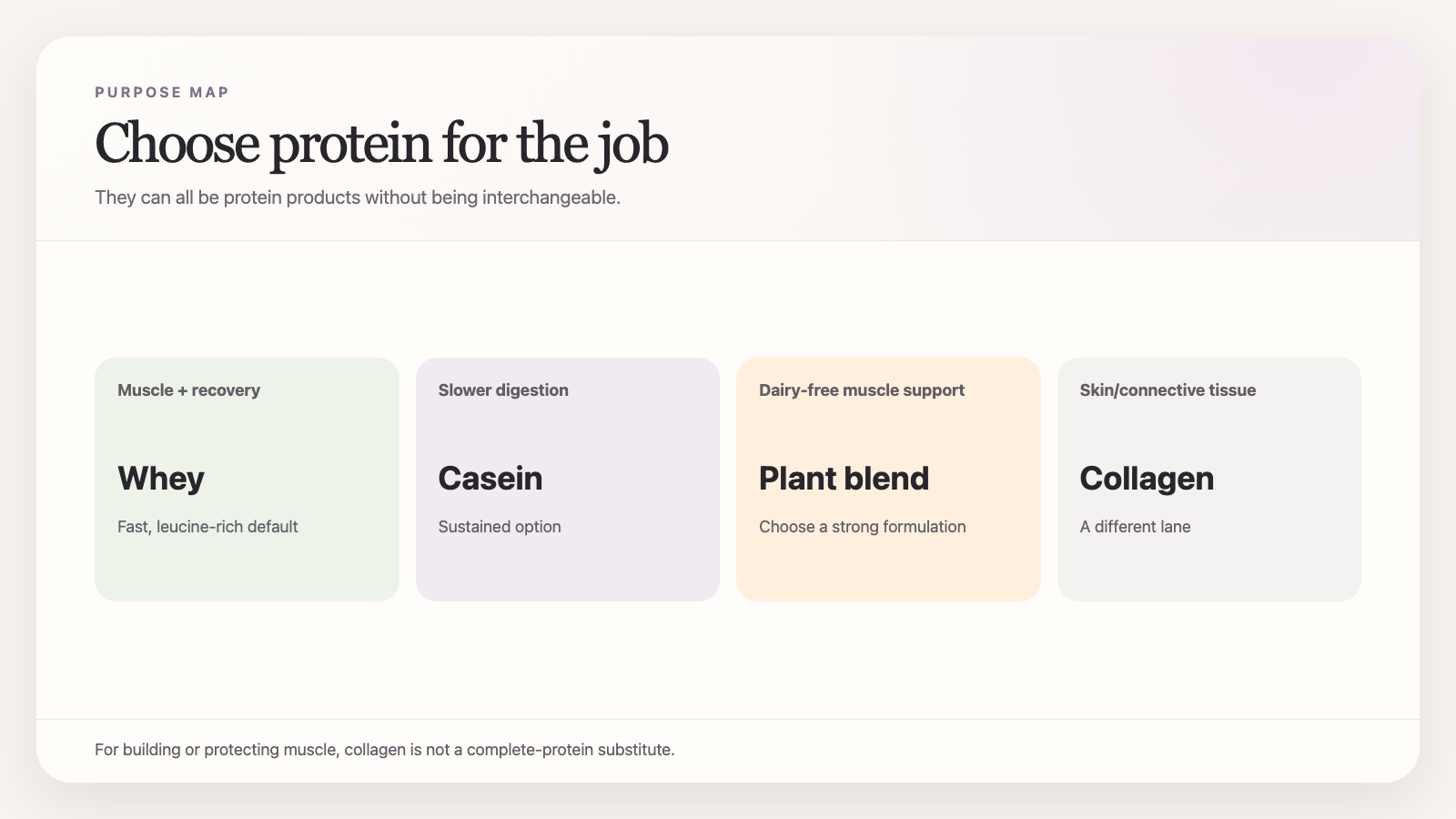 Start with the job: the right protein choice becomes much less mysterious once the goal is explicit.
The most common mistake
Counting collagen as the main protein solution for someone trying to preserve or build muscle is the classic mistake here.
Collagen has a lane. It is just not that lane.
The second mistake is buying a weak plant protein and then concluding all plant protein is inferior. Formulation matters.
What to track
Track:
- total daily protein
- workout recovery
- fullness/satiety
- GI tolerance
- whether the supplement actually helps you hit your goal consistently
That last point matters more than people admit. The best protein powder is not the one that wins an amino acid argument online. It is the one you will actually use consistently in a way that supports the goal you care about.
Ovelia is useful here because "did this actually help my energy, recovery, or consistency?" is a much better question than "which tub had the best marketing copy?"
The bottom line
The simplest ranking is:
- Whey: best default for muscle and recovery
- Casein: useful slower-digesting option
- Plant blends: strong option when well formulated
- Collagen: different lane, better for skin/connective-tissue-oriented goals than for muscle
Do not buy all four. Buy the one that fits the job.
That is usually enough.
Sources:
- Supplemental protein in support of muscle mass and health: advantage whey
- The Role of the Anabolic Properties of Plant- versus Animal-Based Protein Sources in Supporting Muscle Mass Maintenance: A Critical Review
- Plant-based food patterns to stimulate muscle protein synthesis and support muscle mass in humans: a narrative review
- Plant Protein Blend Ingestion Stimulates Postexercise Myofibrillar Protein Synthesis Rates Equivalently to Whey in Resistance-Trained Adults
- Effects of Oral Collagen for Skin Anti-Aging: A Systematic Review and Meta-Analysis
- The effects of collagen peptide supplementation on body composition, collagen synthesis, and recovery from joint injury and exercise: a systematic review
Ready to track what actually works for you?
Ovelia turns what you read into a guided protocol you can actually follow.