 Ovelia.appAvailable on the App Store
Sleep Hygiene: Which Fundamentals Actually Have Evidence
Sleep hygiene is useful, but not every tip deserves equal status. If you want the highest-return basics, focus first on wake-time consistency, light timing, caffeine cutoff, bedroom environment, and not lying awake in bed for hours trying to force sleep.
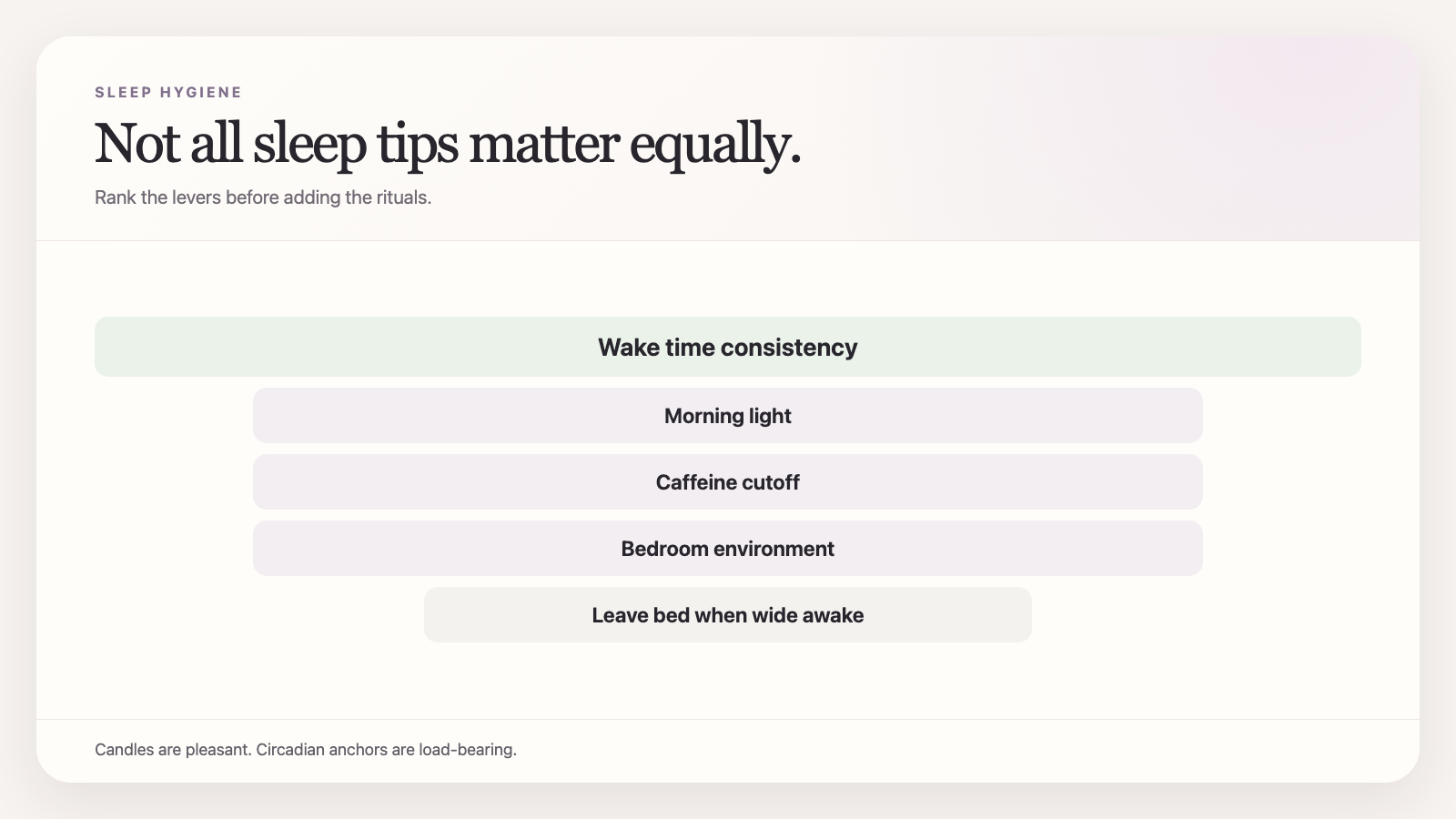 Some sleep advice is load-bearing. Some of it is decorative.
Sleep hygiene gets a weird reputation.
On one side, it is treated like a list of childish rules: no screens, no caffeine, dark room, good luck. On the other side, people dismiss it entirely because it is not as powerful as CBT-I for chronic insomnia.
Both reactions miss the point.
Sleep hygiene is not a cure-all. It is the set of behaviors and environmental conditions that make sleep easier or harder. Some of those levers are weak. Some are genuinely high-value. The problem is that they often get presented like they all matter equally.
They do not.
The highest-return sleep hygiene basics
1. Wake time consistency
If you only keep one anchor, keep this one.
Your body clock cares a lot about when you wake, because wake time helps set light exposure, meal timing, and sleep pressure across the day. When wake time moves all over the place, bedtime usually gets less stable too.
This is one reason people can "sleep in to catch up" and still feel strangely off. Extra time in bed is not the same thing as a stable circadian signal.
2. Morning light
Morning light is so important it barely belongs under the sleepy little label of "hygiene." It is one of the clearest circadian anchors we have.
Natural light soon after waking helps suppress melatonin, support alertness, and reinforce the daytime signal the brain uses to time the next night of sleep. That is why it deserves a top-tier ranking instead of being treated like a wellness side quest.
3. Caffeine cutoff
You can love caffeine and still admit it routinely sabotages sleep when taken too late.
This is one of the highest-return fixes because the effect is predictable and common. If sleep onset or nighttime alertness is a problem, afternoon caffeine is usually guilty until proven innocent.
4. Bedroom environment
The big three here are:
- dark
- cool
- quiet
Not because every person needs monastery conditions, but because temperature, light, and noise reliably change sleep quality. If you sleep hot, sweaty, or easily stirred, this matters more than chasing a fancy supplement stack.
5. Getting out of bed when you are wide awake
This one is less intuitive and more important than most people think.
If you lie in bed awake for long stretches, the brain can start pairing the bed with frustration and alertness instead of sleep. Getting up briefly, doing something quiet in dim light, and returning when sleepier is often more useful than grinding your teeth under the blanket.
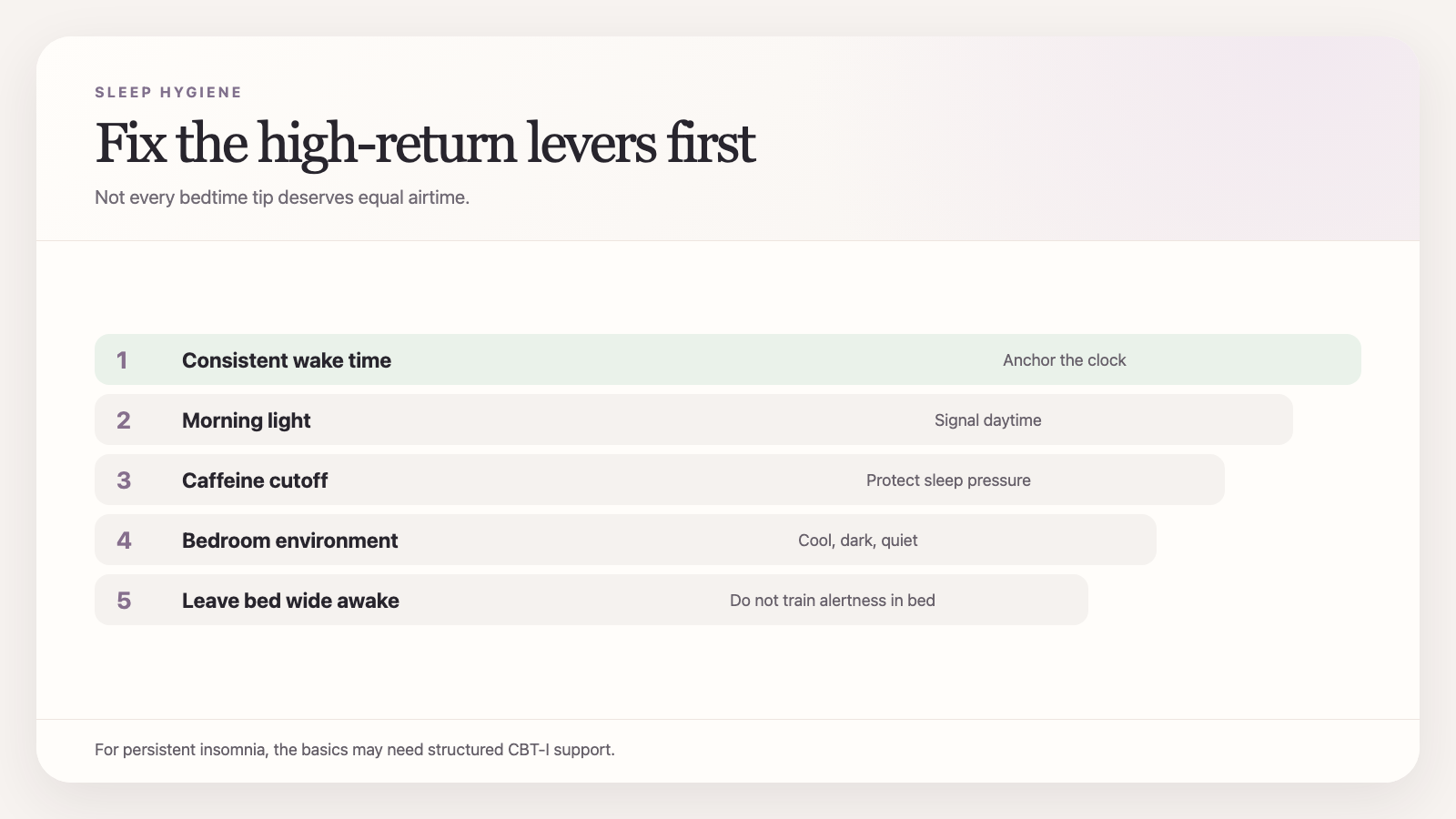 Not all sleep advice is equal; start with the levers that set timing and reduce obvious interference.
The middle-tier stuff
These still matter. They are just not usually the first fix.
Alcohol timing
Alcohol often helps with sleep onset and hurts the rest of the night. More fragmentation, earlier waking, shakier recovery. If sleep quality is poor, late alcohol deserves suspicion fast.
Heavy late meals
Some people do fine. Some do not. Reflux, heat, and discomfort can absolutely make sleep worse.
Exercise timing
This is more individual than people want it to be. Late intense exercise can rev some people up, but others sleep fine after it. If evening training seems to delay sleep, trust the pattern instead of a blanket rule.
What the evidence actually says
A systematic review and meta-analysis of sleep hygiene education found that sleep hygiene alone can help, but it is not the same thing as a full insomnia treatment. That is an important distinction.
If you have persistent insomnia, sleep hygiene is usually necessary but not sufficient. It can improve the conditions around sleep without fully fixing a disorder that also involves conditioned arousal, anxiety about sleep, or other more entrenched patterns.
That does not make the basics pointless. It means you should not ask them to do a bigger job than they were hired for.
The public-health review literature lands in a similar place: the core habits matter, but evidence quality is uneven and the category has often been too vague. Which is exactly why a ranked approach is more useful than endless generic tips.
What does not deserve first-class billing
This is where I get opinionated.
If someone is struggling with sleep and the advice starts with lavender spray, magnesium gummies, or "just make a calming vibe," the priorities are wrong.
Those things can be pleasant. Pleasant is not the same as foundational.
The order should usually be:
- wake time
- light timing
- caffeine timing
- bedroom environment
- bed-awake association
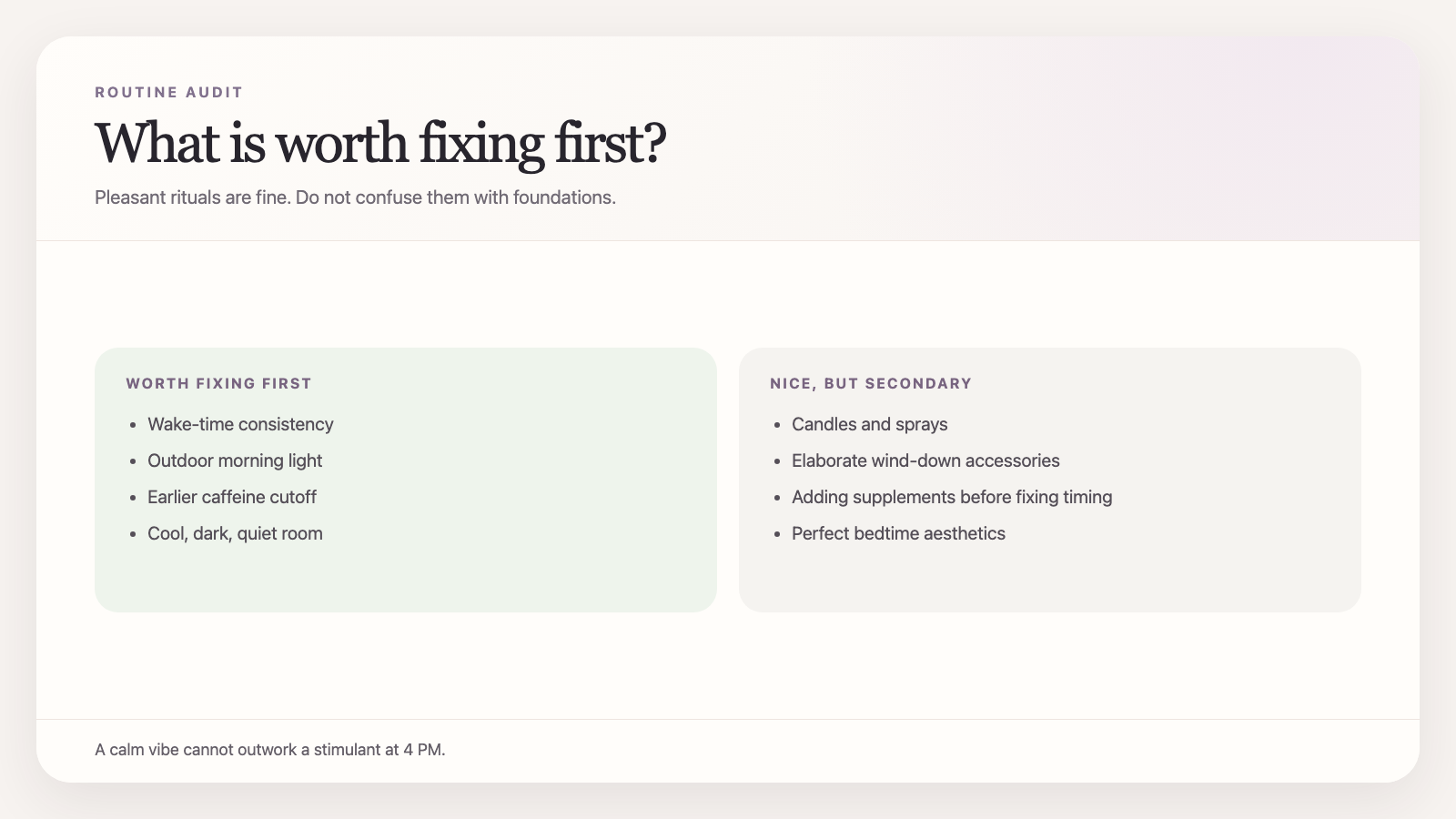 Pleasant routines are fine, but they belong after the factors that reliably push sleep around.
Then you get fancy if you still need to.
When sleep hygiene is not enough
If sleep has been bad for months, if you dread bedtime, if your brain goes hyperalert at night, or if you are spending long periods awake despite being exhausted, that is not a sign you failed at the basics. It is a sign that the problem may be more insomnia-shaped than routine-shaped.
That is where structured approaches like CBT-I tend to outperform simple sleep hygiene alone.
What to track
Track:
- wake time
- first light exposure
- caffeine timing
- sleep onset
- night waking
- next-day energy
That is usually enough to tell whether your "bad sleeper" identity is actually a timing problem in disguise.
Ovelia is helpful here because sleep hygiene only becomes persuasive when you can see the pattern. A cleaner bedtime starts feeling real once it shows up in your sleep and next-day energy data.
The bottom line
Sleep hygiene is not fake. It is just often taught badly.
The highest-return basics are:
- consistent wake time
- morning light
- earlier caffeine cutoff
- cooler, darker, quieter bedroom
- not teaching your brain that bed is where frustration lives
Start there.
If you still need more after that, fair enough. But most people skip the levers that actually matter and then wonder why sleep advice feels useless.
Sources:
Ready to track what actually works for you?
Ovelia turns what you read into a guided protocol you can actually follow.