 Ovelia.appAvailable on the App Store
Sleep Stack Basics: Magnesium, Glycine, L-Theanine, and Apigenin
The best sleep stack is usually the simplest one. If you want to test supplements for sleep without creating a noisy mess, start with one foundation support, match it to your actual sleep problem, and track sleep onset, overnight waking, and next-day alertness for at least 2 to 4 weeks.
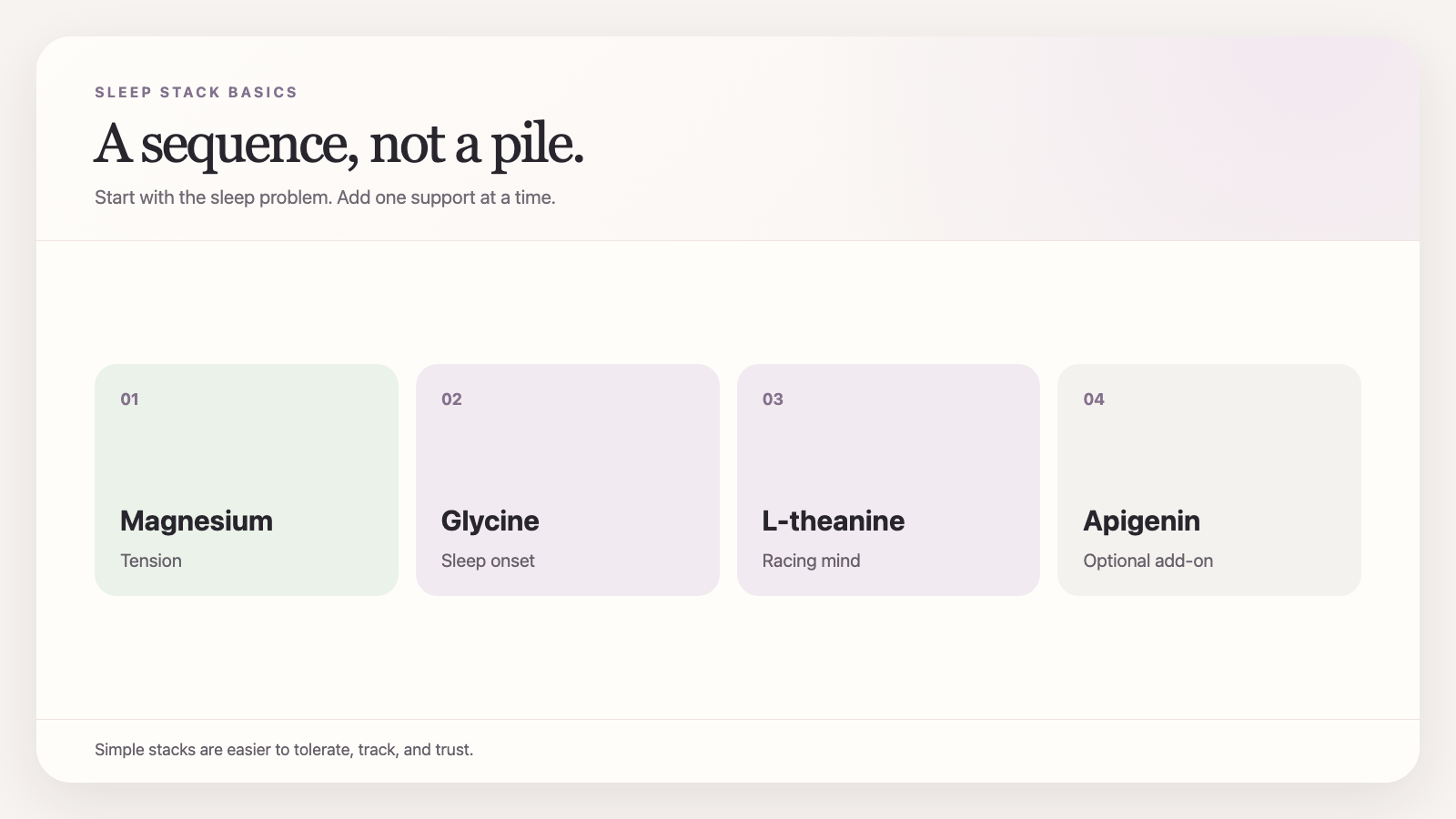 A good sleep stack should look more like a recipe card than a chemistry accident.
Sleep supplement culture has a bad habit of treating more like better.
Magnesium, glycine, L-theanine, apigenin, melatonin, inositol, tart cherry, valerian. Throw them together, hope something lands, and call the whole thing a "night routine."
That is a decent way to spend money and a terrible way to learn what helps you sleep.
The cleaner move is to treat a sleep stack like a protocol:
- define the sleep problem
- match the supplement to the problem
- add one variable at a time
- track the result over a real timeline
Because "poor sleep" is not one thing.
First, get honest about which sleep problem you have
Most people say "I need better sleep" when they really mean one of four things:
- I cannot fall asleep
- I wake up too often
- I wake up too early
- I sleep enough hours but still feel unrestored
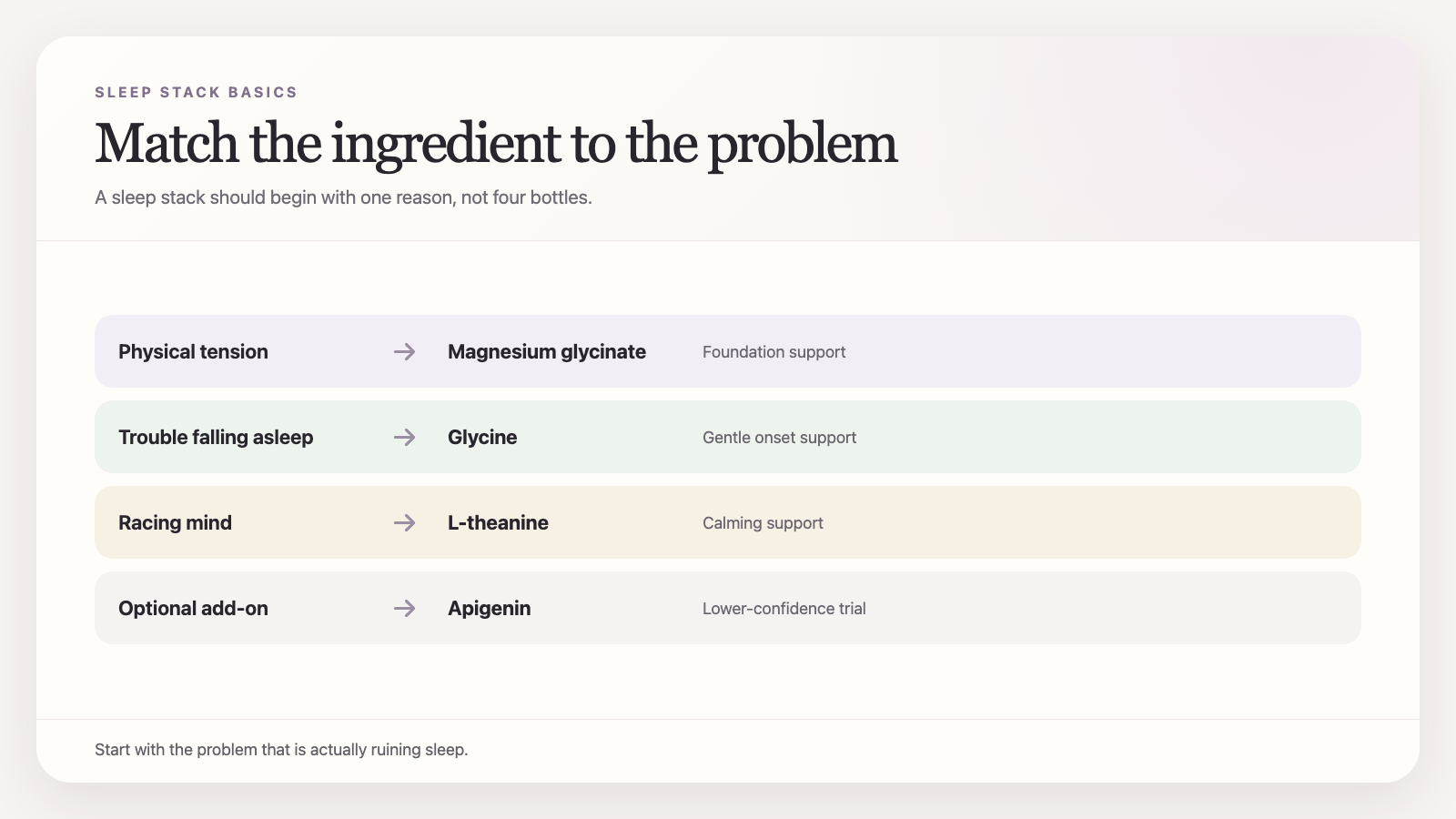 A useful stack starts by matching one ingredient to the sleep problem it is meant to address.
Those are not identical. And the stack that helps with sleep onset is not always the same one that helps with tension or fragmentation.
The four ingredients people talk about most
Magnesium
Magnesium is the most useful "foundation" supplement in the stack because it is tied to nervous system regulation, GABA signaling, and physical tension. It is rarely dramatic, but it is one of the more defensible low-risk sleep experiments.
There is decent though modest evidence that magnesium can improve sleep quality in some people, especially when low intake, stress, or muscular tension are part of the picture. Form matters. Glycinate or bisglycinate usually make more sense than oxide if sleep is the goal.
Best fit:
- physically tense evenings
- stress-related light sleep
- trouble winding down
Glycine
Glycine is interesting because it may help lower core body temperature and support sleep onset and next-day alertness. That makes it more specific than the generic "relaxation" label it often gets.
The data are not huge, but human studies suggest glycine may improve subjective sleep quality and reduce next-day fatigue, especially in people with mild sleep complaints or sleep restriction.
Best fit:
- trouble falling asleep
- feeling groggy the next day
- wanting something gentle rather than sedating
L-theanine
L-theanine is usually best framed as a calming support, not a knockout agent. It may reduce subjective stress and support relaxation, which can indirectly help sleep, especially when mental noise is the actual problem.
The sleep evidence is more limited than supplement marketing implies, but it is plausible enough to use carefully in the right pattern.
Best fit:
- racing mind
- stress carryover from the day
- feeling mentally "on" at bedtime
Apigenin
Apigenin gets a lot of airtime because it is a compound found in chamomile and is often described as mildly sedating through GABA-related effects. The problem is that standalone human sleep data are not especially robust.
That does not mean it is useless. It means the confidence level should be lower. Apigenin belongs in the "possible add-on" bucket, not the "start here" bucket.
Best fit:
- optional experiment after basics are sorted
- people who tolerate chamomile-like calming effects well
What a sane starter stack looks like
If you have never tested sleep supplements before, start here:
Option 1: Tension-heavy evenings
- magnesium glycinate
Option 2: Sleep-onset problem
- glycine
Option 3: Racing mind problem
- L-theanine
Then wait. Watch the pattern. Do not build a four-supplement pyramid on night one.
If you want to combine anything early, magnesium + glycine is one of the cleaner pairings because the mechanisms are different enough to make sense together without immediately turning the stack into sludge.
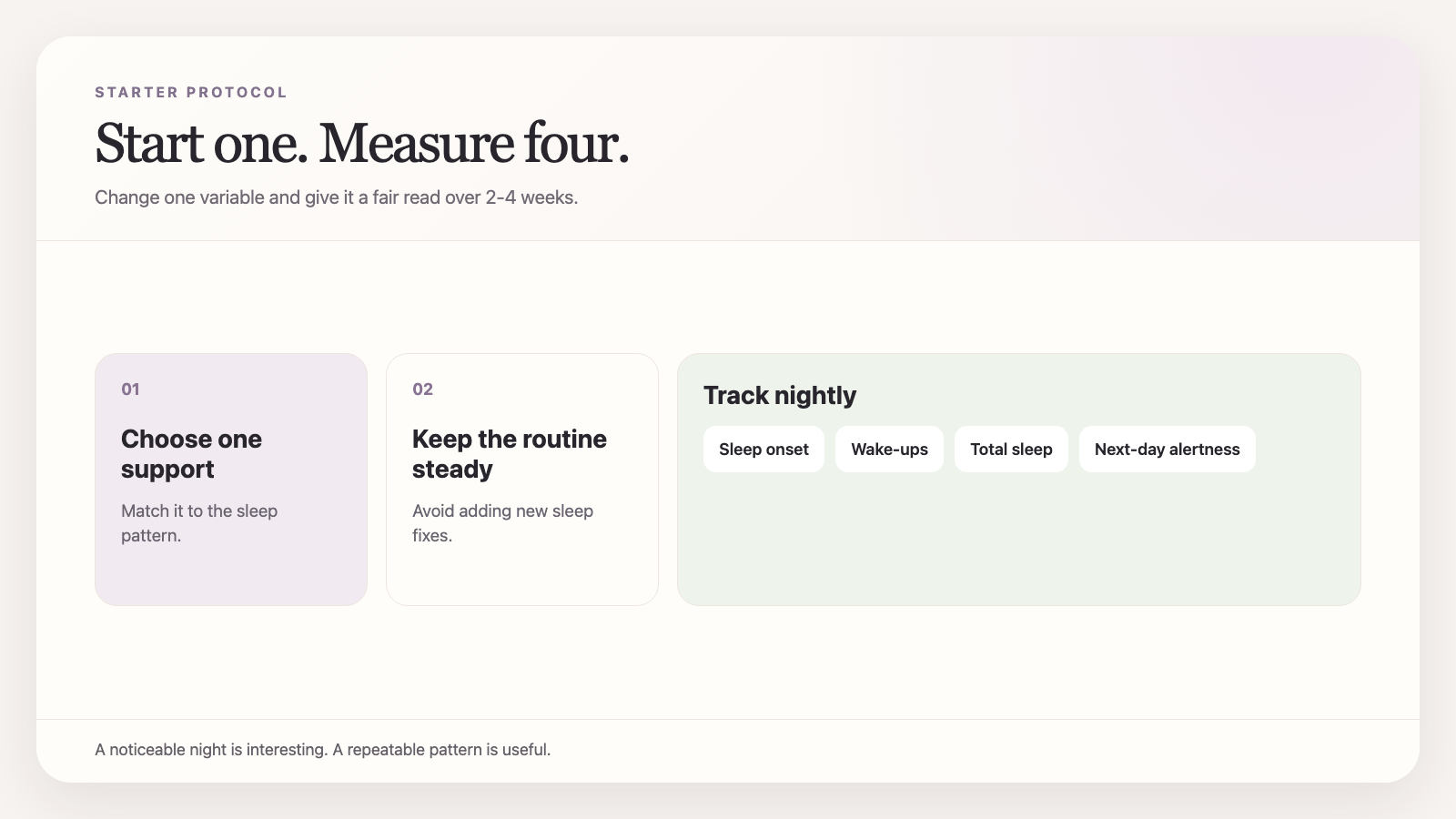 Start one variable and measure the four outcomes that make a sleep change readable.
What the evidence actually says about stacks
This is the annoying part: there is much more evidence for individual ingredients than for the exact influencer-style stacks people now copy.
A recent review of common dietary supplements for sleep quality covers magnesium, theanine, and related options, but the authors are careful not to oversell the category. The evidence is mixed, effect sizes are often modest, and quality varies. Another literature review on herbal and natural supplements for sleep makes basically the same point.
That means a sleep stack should be treated as an experiment, not as a guaranteed fix.
The good news is that you do not need a huge effect to care. If sleep onset drops by 15 minutes and next-day functioning is better, that matters in real life even if it does not look dramatic on TikTok.
The biggest mistakes
Starting too many things at once
This is how people end up with no idea whether magnesium helped, whether glycine helped, or whether the only real effect was placebo plus a better bedtime.
Using the wrong tool for the wrong problem
If your problem is late caffeine and bright screens, no herb is going to heroically solve your choices.
If your problem is fragmented sleep from alcohol, night sweats, or untreated sleep apnea, a tidy supplement stack is not the first intervention.
Judging too fast
Some supplements feel noticeable quickly. That does not mean the read is trustworthy quickly.
Give it at least:
- 1 to 2 weeks for a first impression
- 2 to 4 weeks for a cleaner read
Do not skip sleep hygiene just because the basics are boring
Here is the rude truth: if your sleep routine includes late light, inconsistent wake times, or caffeine too close to bedtime, that usually matters more than adding apigenin.
Supplements can help. They are rarely the whole story.
That does not make them pointless. It just means they work best when the rest of the routine is not actively sabotaging them.
What to track
Do not track "sleep" as one fuzzy feeling. Track:
- sleep onset
- overnight waking
- total sleep time
- next-day alertness
That is enough.
If the stack is helping, you should be able to point to a pattern rather than a vibe.
Ovelia is useful here because sleep stacks are exactly the kind of low-drama experiment people misread without a baseline.
The bottom line
The best sleep stack is usually the least exciting one.
Start with the problem, not the product list.
- Magnesium for tension and stress-loaded evenings
- Glycine for sleep onset and next-day grogginess
- L-theanine for a racing mind
- Apigenin as an optional add-on, not the foundation
Simple stacks are easier to tolerate, easier to track, and much easier to trust.
That is the whole point.
Sources:
Ready to track what actually works for you?
Ovelia turns what you read into a guided protocol you can actually follow.