 Ovelia.appAvailable on the App Store
Supplement Stacking Mistakes That Quietly Blunt Your Results
The fastest way to make supplements confusing is to add too many at once and create interactions you cannot interpret. If you want cleaner results, introduce one supplement at a time, wait long enough for a signal to show up, and separate obvious competitors like iron and calcium instead of taking everything together.
 Too many variables can feel productive right up until you realize you cannot tell what is doing anything.
Adding supplements on top of supplements without clearing the baseline first is one of the most common reasons protocols don't work. You add magnesium, then iron, then a B-complex, then vitamin D, and three months later you feel... the same. So you blame the supplements. Usually the problem is that you changed everything at once and had no way to know which one (if any) was working.
This isn't about whether stacking is bad. It's about the information problem: the more variables you add at once, the harder it is to tell what's actually moving the needle.
The Core Problem: Too Many Variables
Your body doesn't give you a readout. You rely on guesswork: "I feel better," "I have more energy," "my skin looks clearer." But all of these are vague. Did you sleep better last night? Did you stress less? Did the magnesium actually do something, or did you just have a good week?
When you add three supplements at once, you can't answer the question. If you feel better, great, but you've got three things to thank. If you don't feel better, you don't know which one to blame, so you blame all of them and stop.
The fix is simple: add one thing, wait enough time for a signal to show up, then add the next. But before you do that, you need to know which pairs of supplements actually interfere with each other and which don't.
Competitive Absorption: Pairs That Block Each Other
Some supplements genuinely compete for absorption at the intestinal level. These matter most when you're taking them at the same meal.
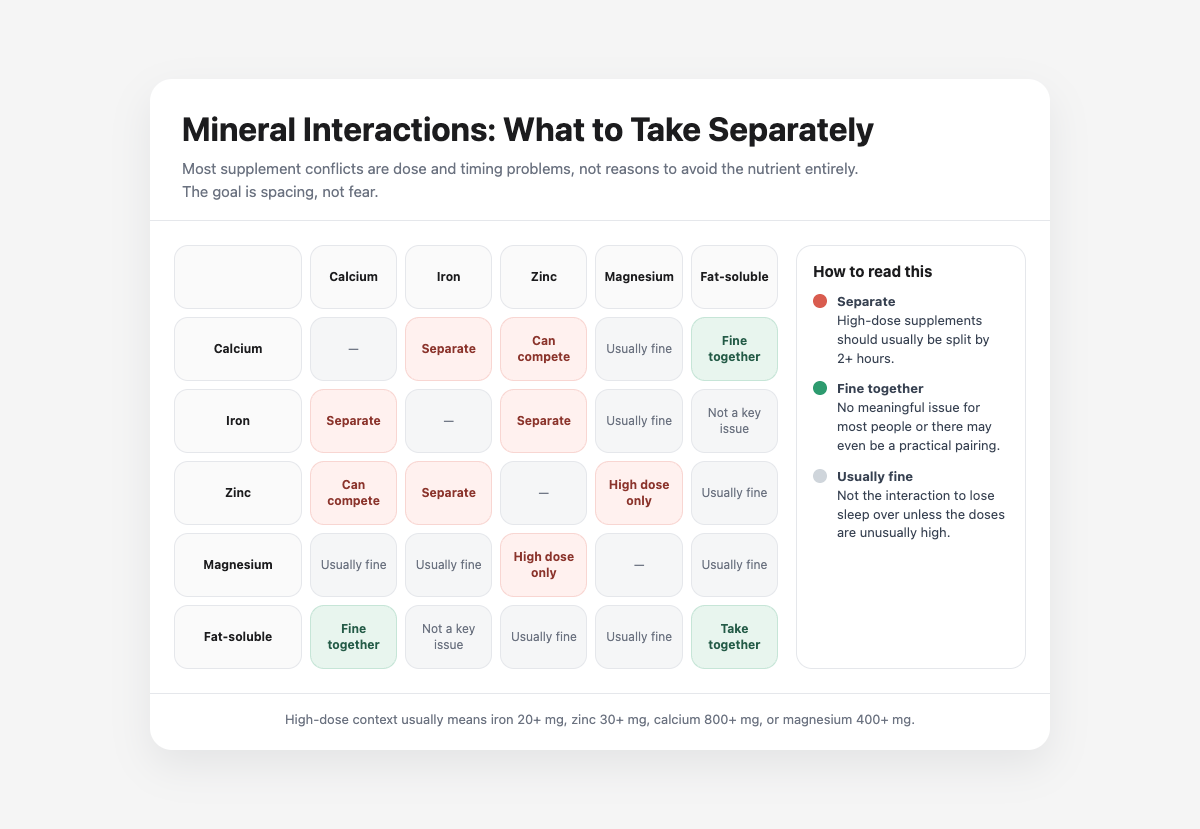
Separating by a full meal (4+ hours) handles most interactions.
Calcium and iron. Calcium doses above 800 mg reduce nonheme iron absorption by about half — this one is dose-dependent and real. If you take an iron supplement with a calcium supplement or a big dairy meal, calcium wins. The fix is simple: take them at different meals, at least a few hours apart. Heme iron from meat is less affected by calcium, but nonheme iron (from plants or supplements) gets blocked significantly.
Zinc and iron. These compete at the transporter level (they both use DMT1). High-dose zinc can deplete iron stores over time, and high-dose iron can reduce zinc absorption. This is more relevant if you're taking high doses of either — like 30+ mg of zinc or iron supplements at the same meal. If you're taking both, separation helps, but the evidence for acute interaction is weaker than the calcium-iron story. Most people don't take high-dose zinc and iron together anyway.
Magnesium and zinc. At very high doses (like 400+ mg of magnesium with 30+ mg of zinc), they can compete, but this is edge-case territory. Normal supplementation doesn't usually trigger this.
Fat-soluble vitamins: A, D, E, K. These absorb better with fat, so take them with food. D and K2 actually work well together — they're complementary, not competitive. Both need fat for absorption, but taking them together at the same meal is fine and probably synergistic.
Timing Conflicts: Stimulants at Night
This is less about absorption and more about sense. B vitamins, especially B6 and B12, can increase alertness. Pre-workout supplements (caffeine, beta-alanine, etc.) are stimulating by definition. If you take these at night, you're working against your sleep.
Taking stimulating supplements after 3 pm or so is a common mistake. You add the supplement, you feel wired, you sleep poorly, and then you wonder why you don't feel better. The supplement is working — just not in your favor.
The same goes for high-dose vitamin C late in the day (it can have a mild diuretic effect) or iron supplements right before bed (which can increase energy and throw off sleep).
The Baseline Problem: Never Knowing What Works
This is the biggest one.
You decide to take magnesium for sleep. That's month one. In month two, you add vitamin D because you read that most people are deficient. In month three, you add an omega-3 because your friend swears by it. In month four, you add iron because your ferritin is low.
Three months later, you do feel better. But which one did it? Or was it the combination? Did the magnesium help? You'll never know, because you can't point to magnesium alone and say "that worked."
Now imagine you feel worse. Or the same. You can't tell which supplement to remove. Do you stop all four? One of them? This is where people get paralyzed.
To build a reliable supplement protocol, test one thing at a time and give it enough time to show a signal. For most supplements, that's at least 4-6 weeks. Sometimes longer (ferritin takes months to move). You track something simple: energy, mood, sleep quality, whatever matters to you. Add the supplement. Wait. Look at the pattern.
Then, and only then, you add the next thing.
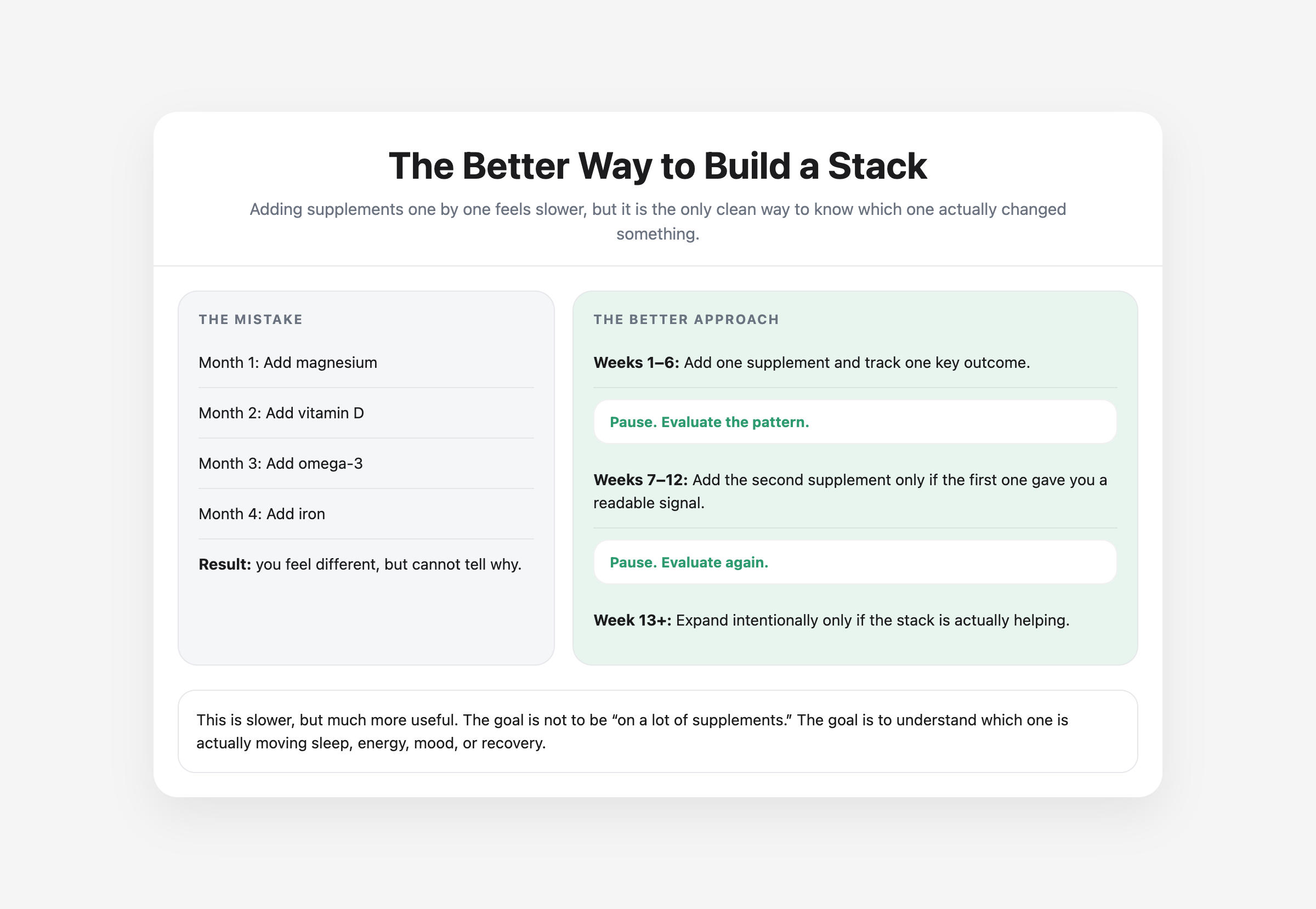 If you want a readable answer, test one addition at a time and give it enough runway to show a pattern.
The Wash-Out Problem: Stopping Without Tracking
The flip side of this mistake is stopping a supplement without tracking what happens, then getting confused about whether it actually did anything.
You take magnesium for a month. You feel fine. You stop (maybe you ran out, maybe you forgot). Two weeks later you're sleeping worse. Did the magnesium do it? Or was it stress? Or did you just have a bad week?
You'll never know, because you didn't log anything while you were on it and you didn't notice the change until it was too late to connect the dots.
If you had tracked sleep quality for the month you were taking it, and then tracked it again after you stopped, you'd have actual data. The magnesium might have added 30 minutes of sleep quality. You might not have consciously noticed, but the data would show it.
This is why "I stopped it and felt fine" is not evidence that a supplement doesn't work. It's evidence that you didn't notice.
What to Track: Why Intuition Fails, and Memory Fails
Here's what gets in the way:
Intuition fails because your body adapts. You start magnesium, and for the first week you sleep amazing — 9 hours a night, dream recall, the works. By week three, you're back to normal. Did the magnesium stop working? No. Your nervous system adapted to the new baseline. You stopped noticing. Your intuition says "this doesn't work anymore," but the data might show you're still getting 30 minutes more sleep than you were before you started.
Memory fails because you're making decisions in real time. It's Thursday night, and you're tired. "Magnesium doesn't work," you think. By Friday morning, you've forgotten how tired you were on Tuesday. You've also forgotten whether you slept well or poorly last week. Memory is terrible at this. It's not lazy — it's just not built to track gradual changes.
The fix is to track something simple. Not obsessively. A one-to-three-word note each day about energy, mood, or sleep quality. A number on a 1-10 scale. Something you can look back on three weeks later and see: "Oh, look. I was more irritable before I started zinc. Now I'm not."
If you want help keeping that kind of experiment clean, Ovelia is built for exactly this: one protocol, one set of reminders, and one place to compare baseline against what happened next.
The people who figure out which supplements actually work for them are doing exactly this. Not because they're special. Because they track one variable at a time and let the signal emerge before adding the next.
See Also
- Post 1: Magnesium Glycinate vs. Oxide — What Your Gut Actually Absorbs — absorption differences between forms
- Post 2: Creatine for Women — Why You Might Need It — adding a supplement to your baseline
- Post 3: How Long Do Supplements Actually Take? — timeline expectations and adaptation
- Post 4: The Supplement Timing Guide — When (and Why) It Matters — spacing supplements throughout the day
Sources:
-
Calcium is a noncompetitive inhibitor of DMT1 on the intestinal iron absorption process: empirical evidence and mathematical modeling analysis — Shows that calcium blocks iron absorption in a dose-dependent manner at 800 mg+
-
Iron and Zinc Homeostasis and Interactions: Does Enteric Zinc Excretion Cross-Talk with Intestinal Iron Absorption? — Documents competitive absorption between zinc and iron at the transporter level
Ready to track what actually works for you?
Ovelia turns what you read into a guided protocol you can actually follow.