 Ovelia.appAvailable on the App Store
The Complete Guide to Supplement Timing and Absorption
Supplement timing matters because absorption rules are different for fat-soluble vitamins, minerals, and stimulatory compounds. The simplest way to improve your results is to take vitamins A, D, E, and K with a fat-containing meal, separate iron from calcium and coffee, keep energizing supplements earlier in the day, and build a repeatable schedule you can actually follow.
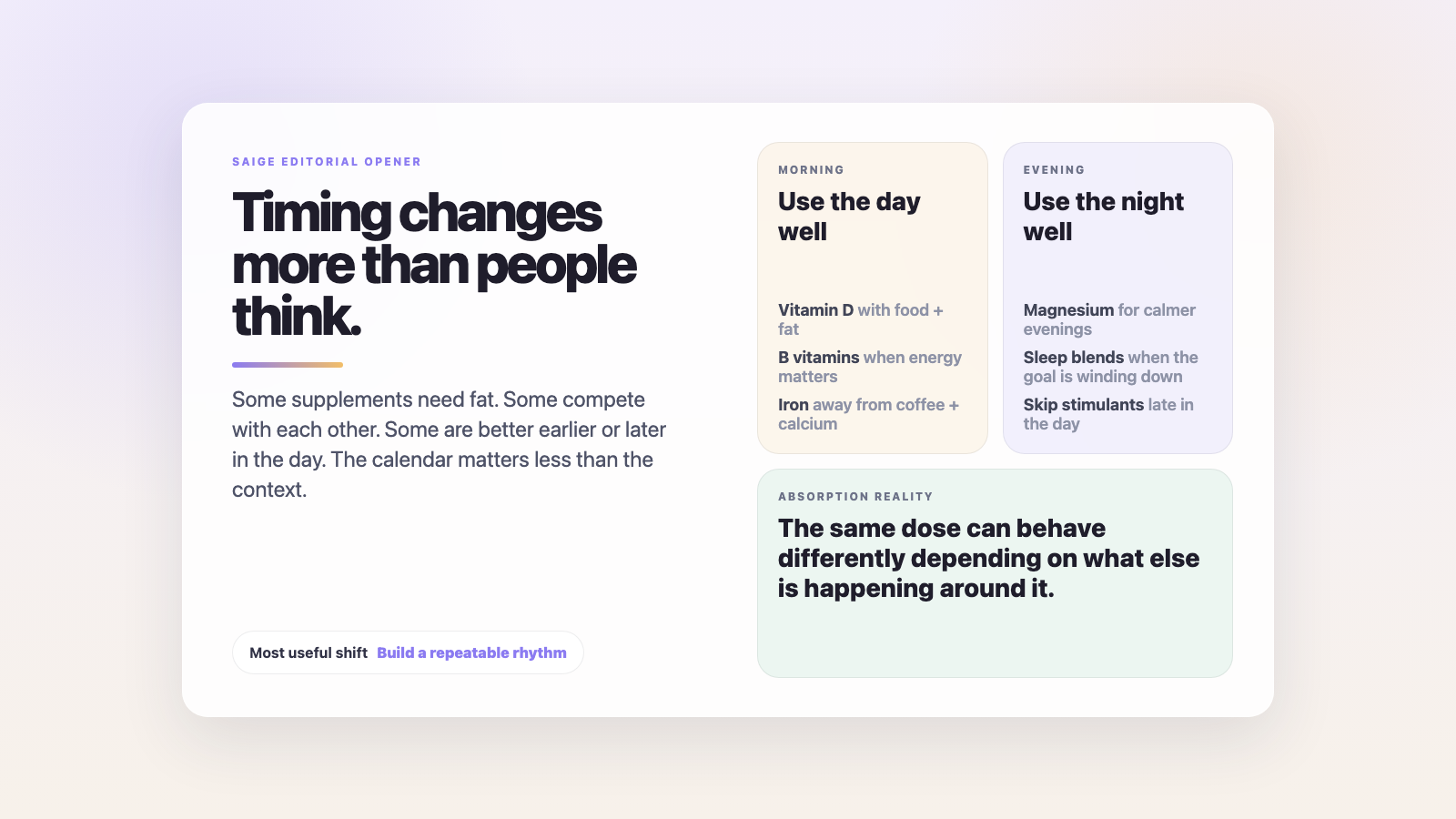 The clock matters less than the context: food, competing nutrients, and what time of day you are asking the supplement to do its work.
When you take a supplement matters almost as much as what you take. Most people never think about it.
You've been taking that vitamin D every morning for three months. You added magnesium at night. You switched to a prenatal with iron. And honestly? You still can't tell if any of it's working. You've done the research, bought the good brands, set the reminders. But there's a gap between intention and outcome that no amount of consistency seems to close.
This is what absorption timing reveals: you can take the perfect supplement at the worst time, and it becomes something your body barely uses at all.
Why Timing Isn't Just About When You Remember
Most people think supplement timing is a wellness myth. Something Instagram invented to sell more products. It's not. It's based on how your body actually processes substances.
When you swallow a supplement, it doesn't instantly become available to your cells. It has to travel through your stomach, be absorbed in your small intestine, survive first-pass metabolism in your liver, and finally reach your bloodstream in a form your body can use. That whole journey is called bioavailability. And timing directly affects whether you get 70% of what you paid for or 20%.
Here's what most people miss: some supplements are absorbed well with meals. Others are blocked by food. Some compete with each other for the same absorption pathway, meaning you could take iron and calcium at the same time and absorb less of both. Others are passed through your liver so quickly that timing changes everything.
This isn't complicated. But it does require you to think about supplements differently than most guides suggest.
Fat-Soluble vs. Water-Soluble: The First Division
The biggest timing rule comes down to one simple fact: some vitamins need fat to work.
Fat-soluble vitamins are vitamins A, D, E, and K. They dissolve in fat, which means they require dietary fat to be absorbed. When you take vitamin D on an empty stomach, your body can't actually use it well. The vitamin sits in your intestine, waiting for fat to show up so it can be broken down and absorbed. If you're taking it without a meal, you're wasting a big chunk of that dose.
Research on vitamin D absorption is particularly clear on this. Studies show that taking vitamin D with a meal containing fat increases peak plasma vitamin D levels by roughly 32% compared to taking it without fat. That's not a small difference. That's the difference between a dose that works and a dose that mostly passes through.
Water-soluble vitamins are different. B vitamins and vitamin C don't need fat. They dissolve in water, so they're absorbed through different intestinal pathways. Timing matters for these, but not because of fat. It matters because your body can only absorb so much at once, and you pee out the excess. More on that later.
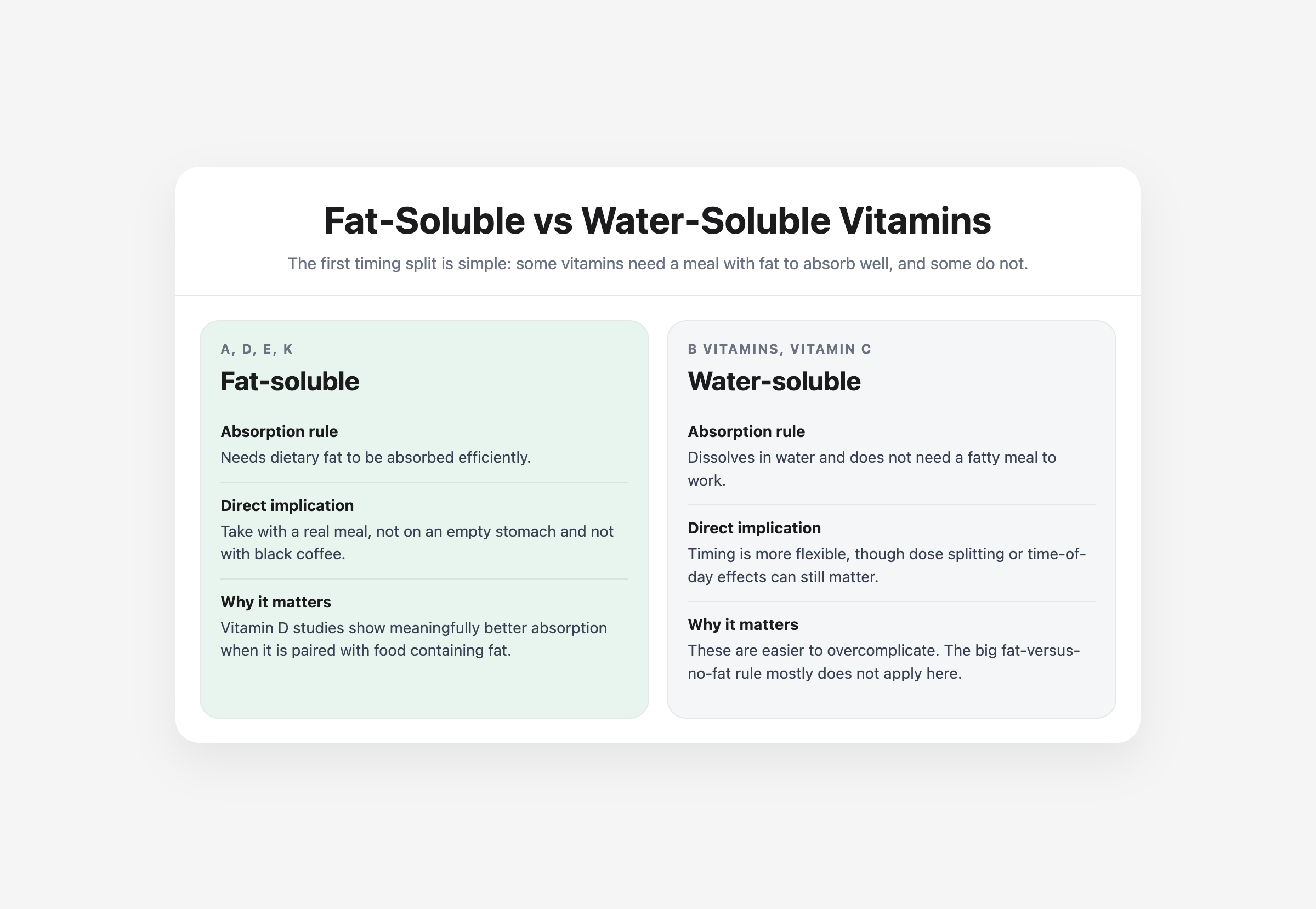 This first split is the easiest absorption rule to get right: A, D, E, and K with fat; water-soluble vitamins are more flexible.
With Food, Without Food, or Doesn't Matter
The simple version: fat-soluble vitamins go with a meal that contains fat. Everything else depends.
Vitamins A, D, E, K: Take these with your meal, ideally the one with the most fat. A breakfast with eggs and avocado, lunch with salmon, dinner with olive oil and protein — any of these works. You don't need a huge amount of fat, but you need enough. Studies suggest even modest amounts of dietary fat (around 10-20 grams) improve absorption significantly.
Iron: This one's tricky. Iron absorbs better on an empty stomach, but most people can't tolerate it that way. The compromise: take it with something that has a small amount of food but not much calcium or coffee. A banana, orange juice, or just water works better than taking it with breakfast. If nausea is an issue, take it with a light snack rather than nothing, because some absorption is better than throwing it up.
Calcium: Empty stomach is actually best, but it's so commonly taken with food that "with a meal without iron" is the practical rule. The key is separation from iron, not separation from food.
Magnesium: Absorption is somewhat better with food, but the bigger factor is which form you're taking. Magnesium glycinate, threonate, and malate tend to be better absorbed than oxide. Timing matters less than form, though taking it with food reduces GI upset.
B Vitamins and Vitamin C: No specific food requirement. These water-soluble vitamins don't need fat for absorption. But because you can only absorb a certain amount at once, split doses work better than one large dose if you're taking high amounts. And taking them with food reduces stomach irritation.
Zinc: Better absorbed on an empty stomach, but again, nausea is real. If you can tolerate it empty, do that. If not, a light meal is fine. Just keep it separate from iron and calcium.
The pattern: the "rule" for timing exists, but your tolerance matters. If empty stomach means you don't take it consistently, the best timing is the one you'll actually use.
Timing By Goal: When You Actually Want the Effect
This is where timing gets practical instead of theoretical.
Morning supplements usually mean vitamins you want systemic availability for all day: vitamin D, B vitamins, magnesium (for some people). Vitamin D makes sense in the morning because it affects circadian rhythm and hormone production throughout the day. B vitamins drive energy, so morning is logical. Iron, if you're taking it, goes in the morning because iron can interfere with sleep.
Evening supplements usually means calming minerals and ingredients that support sleep: magnesium, glycine, any herbal sleep blend. These work because your body actually uses them for the physiological processes that happen at night. Taking magnesium at night isn't magic. It's timing the supplement to when your body is performing the function it supports.
Around training: This is where supplement timing actually gets detailed. Creatine timing doesn't matter much — what matters is consistent daily intake. Pre-workout nutrients like caffeine and beta-alanine make sense close to the workout for immediate effects. Post-workout protein timing is less critical than total daily protein intake, but if you're taking it, shortly after training uses the "anabolic window" idea (which is real but smaller than popular culture suggests). Carbohydrates with protein post-workout do help with recovery, and timing it within a couple hours of training makes sense.
The biggest takeaway: morning vs. evening matters for certain supplements because of how they interact with your circadian rhythm and daily physiology. But for most people, "consistent" beats "perfectly timed" by a huge margin.
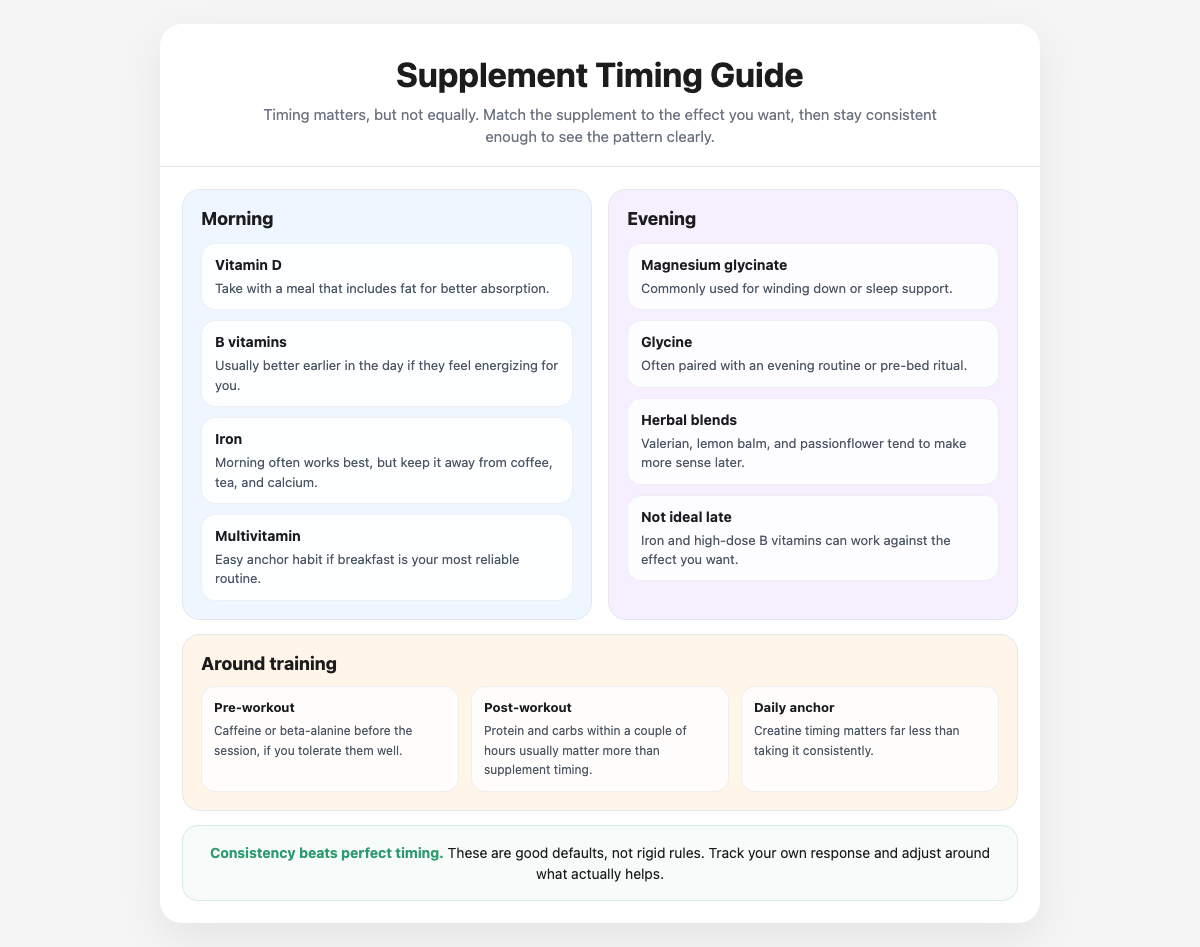 General guidelines. Consistency matters more than perfect timing.
Competitive Absorption: What Blocks What
This is the part most guides skip, and it's where real problems happen.
Your body uses specific transporters to absorb minerals. Iron and zinc both use a transporter called DMT1. When you take iron and zinc together, they compete for the same absorption pathway. Research shows that zinc absorption decreases significantly when you take it alongside iron, especially in liquid form. Small amounts of iron don't block zinc much, but high-dose iron supplements do genuinely reduce zinc uptake.
Calcium is even more competitive. Calcium inhibits iron absorption, particularly non-heme iron (the kind from plant sources and supplements, not red meat). Studies show calcium can reduce iron absorption by 50% or more if you take them together. This is why iron supplements come with the instruction to take them alone or at least two hours apart from other minerals.
Calcium and zinc seem to interact, but it's more nuanced. Calcium doesn't directly block zinc, but when combined with compounds called phytates (found in grains and legumes), calcium can interfere with zinc absorption.
The practical rule: if you're taking iron, zinc, or calcium at high doses, separate them. Iron and zinc should be 2+ hours apart. Calcium should be 2+ hours from iron, ideally. If you're taking a multivitamin with mixed minerals, the doses are usually small enough that competition doesn't matter much. But if you're doing separate supplements for a specific reason, timing matters.
For magnesium and most B vitamins, this interaction problem is much smaller. They use different absorption pathways and don't compete significantly.
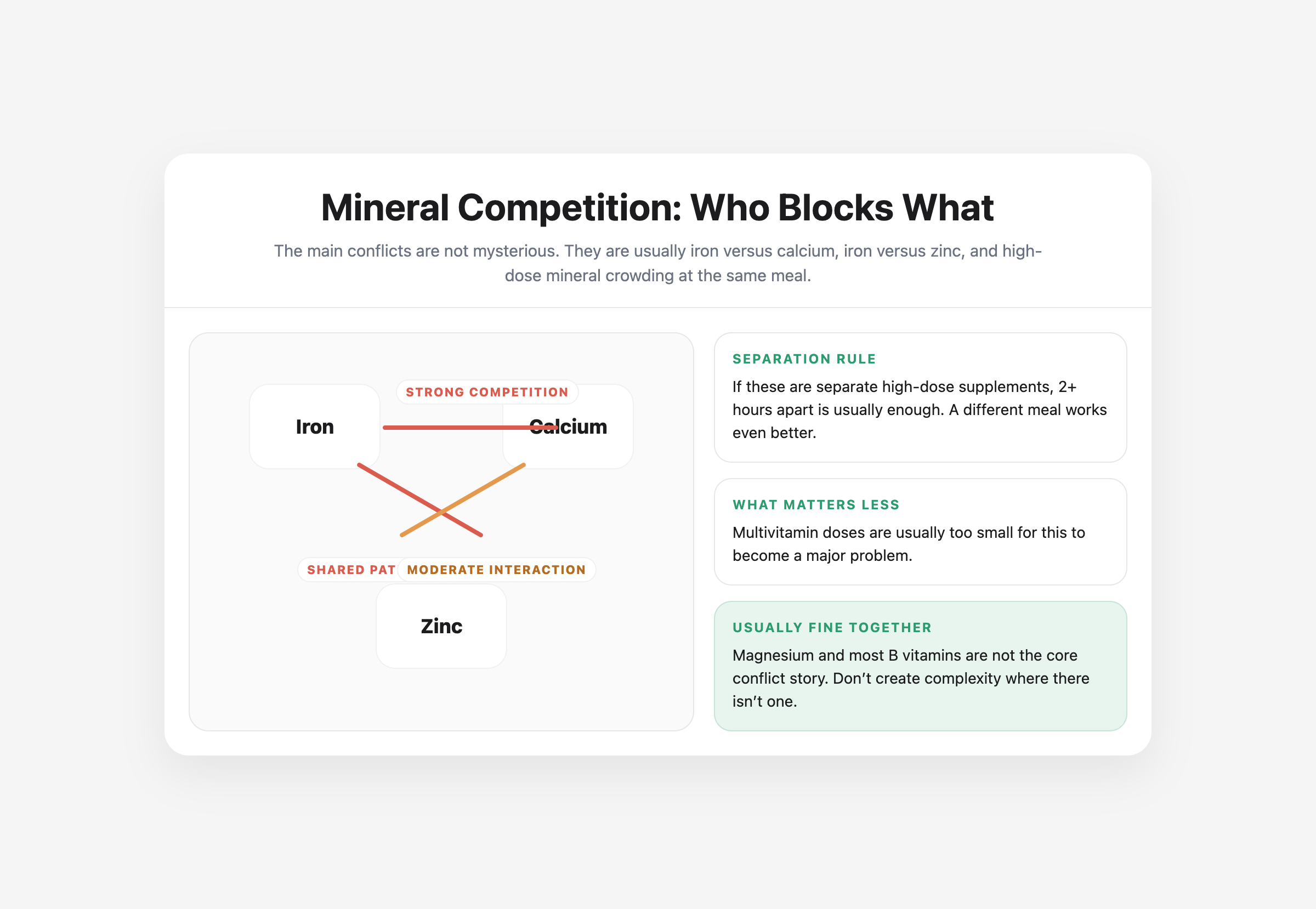 The biggest conflicts are usually iron versus calcium and iron versus zinc, not every mineral in the cabinet.
Why You're Different From Everyone Else (And That's The Whole Point)
Here's where research gets honest: the right supplement timing is not the same for everyone.
Your genetics affect your liver enzymes. If you're a "fast metabolizer" of certain compounds (determined by cytochrome P450 enzyme variants), you might process supplements more quickly, meaning timing changes what you actually absorb. If you're a slow metabolizer, you might not need to split doses because you process things more slowly anyway.
Your digestive system affects absorption rate. If you have low stomach acid, you'll absorb minerals differently than someone with normal acid production. If you have bile issues, fat-soluble vitamin absorption changes. SIBO, IBS, or any inflammatory gut condition affects what you actually absorb, regardless of timing.
Your food timing affects everything. If you eat a big breakfast, take supplements mid-morning, then don't eat again until lunch, the timing context is totally different than for someone who grazes all day.
Your hormones affect absorption. Women's absorption of iron and calcium changes with the menstrual cycle. Pregnancy changes how you absorb and store nutrients. Estrogen levels affect mineral absorption. This is why the same supplement protocol doesn't work identically for everyone.
Age affects absorption. As you get older, stomach acid production decreases, which reduces mineral absorption across the board.
The research is clear: the timing that works for you might not work for someone else. The rule is the starting point, not the destination.
What To Track (Because Intuition Fails Here)
This is the part where most people give up. You take supplements for weeks, feel... fine, and have no idea if it's working.
Intuition fails with supplements because the effects are subtle and slow. If you take an antibiotic, you feel better in days. If you take a supplement, you might feel nothing for months, or you might feel better so gradually that you don't notice the change. Then you skip the supplement, and you don't notice it's gone until weeks later. By that point, you can't remember what timing you used or whether you even took it consistently.
Memory fails for the same reason. You took it most days, but did you miss it on weekends? Did you take it with breakfast or lunch or just whenever you grabbed the bottle? You probably don't know. Your brain didn't encode it as important because the effect was invisible.
Tracking is the only way to separate what's actually working from what you think is working. And the variable most people never track is timing.
Most people track whether they took the supplement. Good. But they skip tracking when and with what. That's where the real information is. Did you take magnesium with food or without? Before bed or earlier? What did your sleep actually look like? Did you take iron with coffee or alone? How did your energy shift?
If you want an easier way to do that in real life, Ovelia can help you keep supplement timing, reminders, and outcome tracking in one place. After 4-6 weeks, you have something much better than a hunch.
You'll probably find one of three patterns.
Timing makes no difference for you. That's good news. You can keep it simple.
Timing shifts everything. You'll suddenly understand why you couldn't tell if something was working before.
Consistency matters way more than timing. Which means stop optimizing the clock and just take the thing every day.
You won't know until you track it. And guessing will cost you real money and time without any actual benefit.
Build Your Own Protocol
The supplement industry wants you to believe there's a universal answer to timing. There isn't. What you have instead is a set of principles, patterns that usually work, and variation that's completely real.
The principles: fat-soluble vitamins need fat. Minerals compete. Your metabolism changes throughout the day. Your genetics and digestion aren't the same as someone else's.
The patterns that usually work: iron and zinc go separate. Magnesium at night tends to help. Vitamin D with your biggest meal makes sense.
The variation is real. That's where your actual results come from. You're building a protocol that fits your life, your body, your goals. Not a protocol that's meant to work for everyone.
That's what tracking reveals. You move from following rules to actually understanding what works for you. And then supplements become something you're doing on purpose, not just something you hope is working.
Sources:
Ready to track what actually works for you?
Ovelia turns what you read into a guided protocol you can actually follow.