 Ovelia.appAvailable on the App Store
Vitamin D and Mood: What the Research Actually Says
Vitamin D can help mood, but the clearest benefit shows up when someone is actually deficient and gives the correction enough time to work. If mood is your goal, check your baseline vitamin D status if you can, supplement consistently rather than randomly, and track mood and energy for 8 to 12 weeks instead of expecting a fast shift.
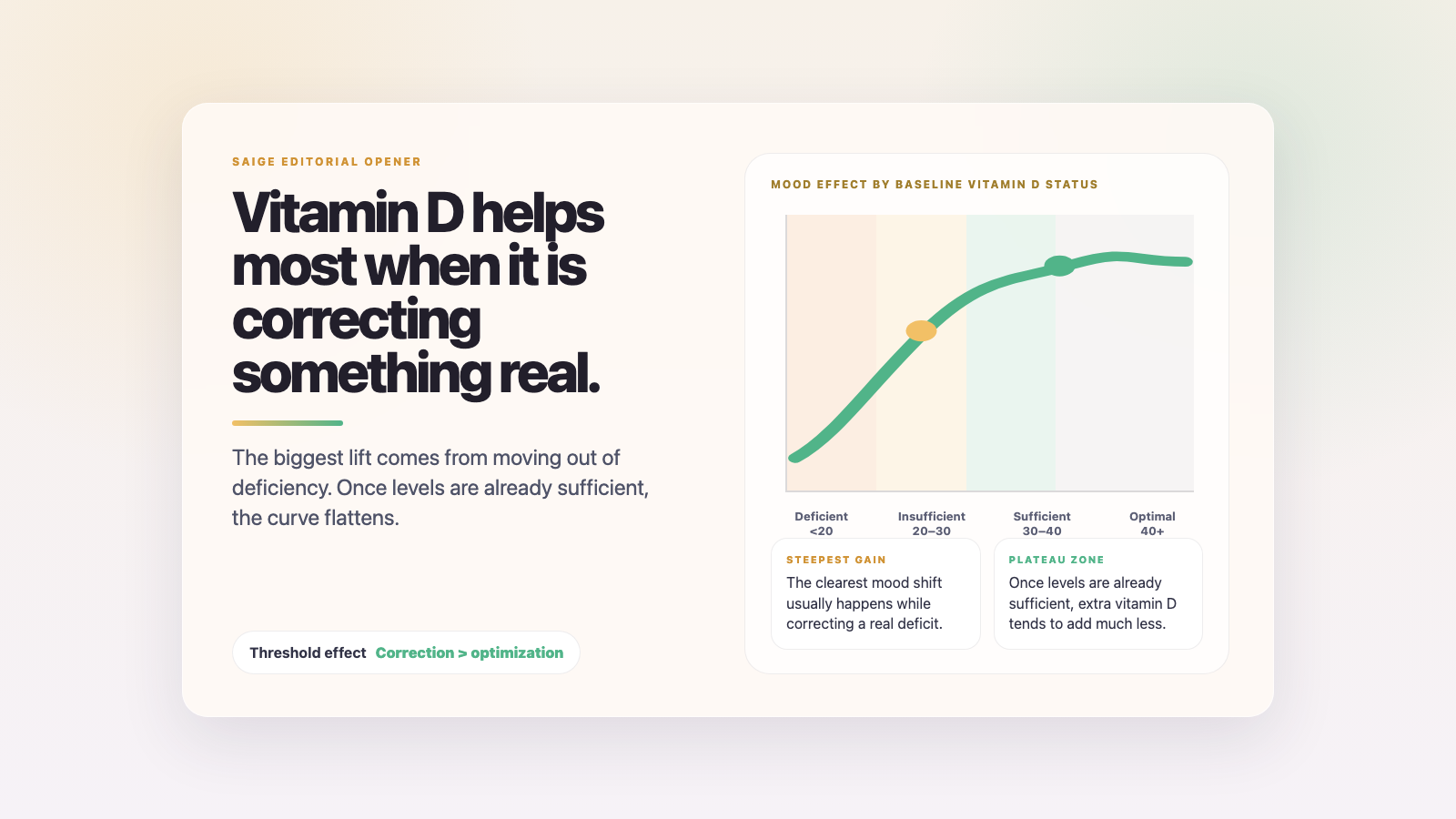 Vitamin D is most useful when it is correcting a gap, not endlessly “optimizing” an already adequate baseline.
You've probably heard that vitamin D helps with mood. Maybe you started taking it because of a rough winter or a particularly dark season. And if you're honest, you have no idea if it's actually working.
This is the awkward truth: vitamin D is routinely recommended, the research supports some benefit, but most people taking it have no baseline for comparison. You can't feel a deficiency the way you feel a broken arm. You can't easily tell if crossing from "deficient" to "sufficient" changed anything in your actual life.
The research does say something specific. So does deficiency data. And here's what matters most: tracking.
The Evidence Is Real, But With Conditions
A 2024 meta-analysis of 41 randomized controlled trials (53,235 participants) found that vitamin D supplementation reduced depressive symptoms with a standardized effect size of -0.317. That's measurable. That's consistent. But it also means we're talking about a mild to moderate improvement, not a cure.
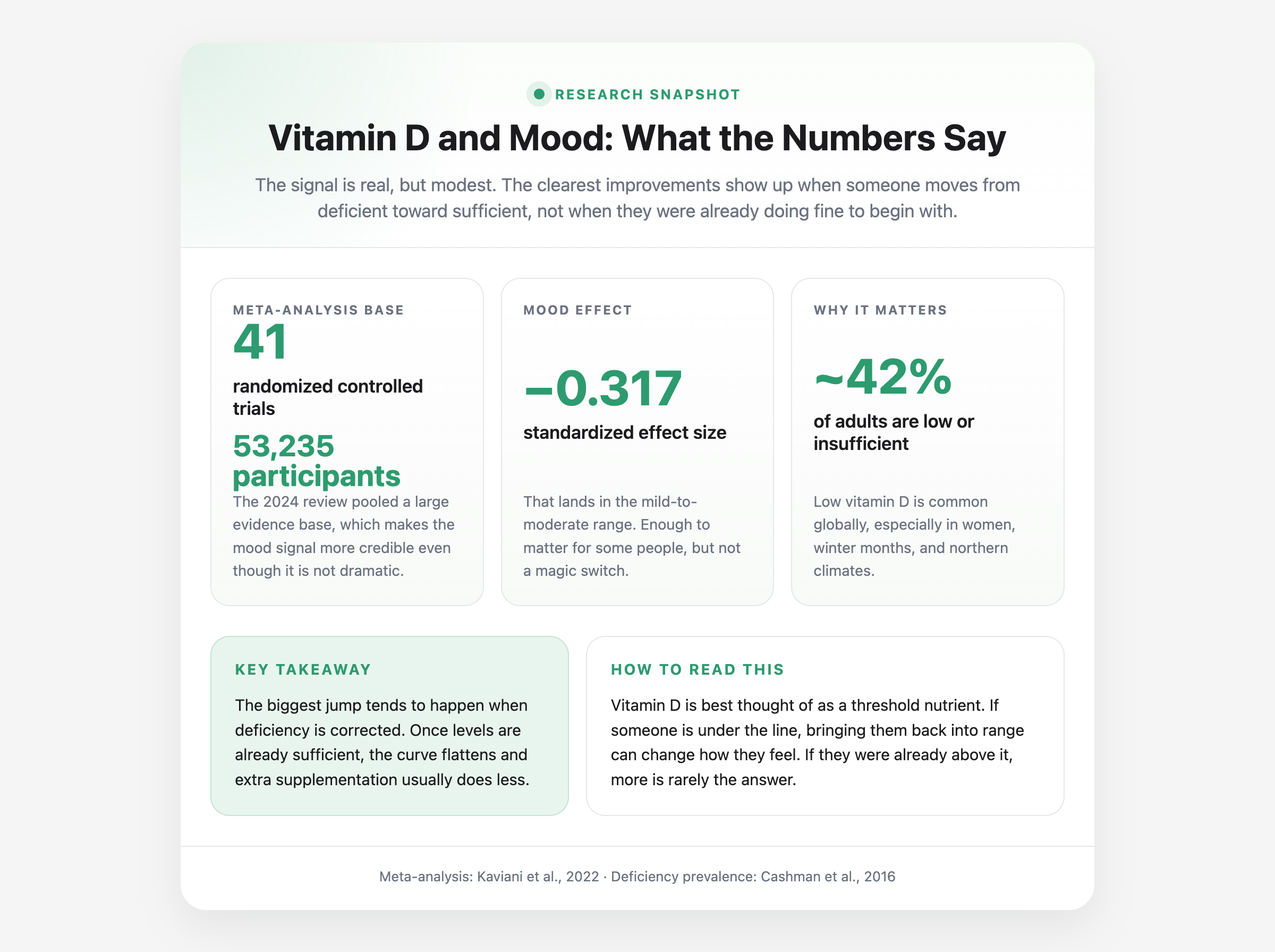 Meta-analysis data: Kaviani et al., 2022. Deficiency prevalence: Cashman et al., 2016.
The more important finding: the effect was stronger in people who actually had depressive symptoms at the start. If you're supplementing vitamin D hoping to prevent depression in normal mood, the evidence is much thinner. The biggest benefit appears for people correcting a deficiency—moving from "severely low" to "adequate"—rather than trying to optimize someone who's already normal.
The research also shows dose matters, but not in the way you might think. The effect increased up to about 8,000 IU per day, then plateaued. More isn't better past that point.
Deficiency Is Common (Especially for Women)
Vitamin D deficiency is widespread, particularly in northern climates, in winter months, and in women. The typical threshold is 20 ng/mL as "deficient" and 30 ng/mL as "sufficient," though some research argues for higher targets around 40 ng/mL.
Here's what matters: getting from 15 ng/mL to 35 ng/mL is a very different intervention than getting from 35 ng/mL to 55 ng/mL. The research on mood benefits is strongest for the first one. Correcting actual deficiency shows the clearest effect.
Women, especially, tend to see stronger mood responses to vitamin D correction than men do. This might relate to hormonal interactions, or simply that women report mood changes more readily, or both. Either way, the data shows the effect isn't equal across everyone.
The Timeline Is Longer Than You Think
Most people expect to feel better in a few weeks. The research consistently shows effects appearing over months, not weeks. The meta-analysis found the largest mood improvements at follow-up periods shorter than 24 weeks, with many trials running 8–12 weeks to see clear effects.
If you just started vitamin D three weeks ago and you're not noticing anything, you're on a completely normal timeline. The biochemistry takes time: vitamin D has to accumulate, your serotonin pathways have to respond, and your mood patterns have to shift enough to be noticeable against the normal ups and downs of daily life.
What to Track
Here's where individual variation makes or breaks the supplement decision: two people with identical vitamin D levels can experience completely different mood impacts.
Intuition fails you here. You can't remember how you felt three months ago accurately. Memory smooths the peaks and valleys. You can't isolate vitamin D from everything else either: sleep, stress, exercise, social connection, seasonal factors. Your brain knows you started a supplement, which creates its own expectation effect on top.
Tracking solves this directly. Pick a simple format: a 1–10 scale, or just three words like energetic, flat, or low. Log it every few days. After 8–12 weeks, look at the data. Did your low-mood days become less frequent? Did your range shift higher? That's the only way to know if the effect is real for you, not just something you expected to see.
The people who figure this out track it. They don't guess.
Dosing Reality
The research supports several approaches:
- Maintenance (if you're already sufficient): 1,000–2,000 IU per day keeps you in range
- Correction (if you're deficient): 4,000–5,000 IU per day to move the needle faster, though even this takes weeks to months
- Timing: Take it with a meal containing fat—vitamin D is fat-soluble, so absorption is better with food
Your baseline blood level matters. If you're severely deficient (under 20 ng/mL), the 4,000–5,000 IU range makes sense. If you're mildly low (20–30 ng/mL), the lower end might be enough.
One more honesty check: the research doesn't support megadosing. Beyond about 8,000 IU, you're not getting more mood benefit. You're just maintaining higher levels, which may or may not be necessary for you individually.
The Honest Takeaway
Vitamin D supplementation has real evidence supporting mood benefits, especially if you're deficient. The effect is real but modest. It's not a treatment for major depression, but it's a reasonable lever to pull if your baseline is low, particularly if you live somewhere with limited sun exposure.
The catch: you probably won't feel dramatically different. You might feel slightly better. You might feel the same. The only way to know is to track—to have a baseline, a timeline, and data instead of intuition.
If you're considering vitamin D for mood, get your blood level checked first. Supplementing when you're already sufficient won't help. And if you do supplement, give it 8–12 weeks, track your actual mood during that time, and then look at the data.
That's how you move from "routine recommendation" to "evidence-based decision for me."
Sources:
- The effect of vitamin D supplementation on depression: a systematic review and dose–response meta-analysis of randomized controlled trials. Ghaemi S, Zeraattalab-Motlagh S, Jayedi A, Shab-Bidar S. Psychological Medicine. 2024 Nov;54(15):3999–4008.
- Effect of Vitamin D Supplementation on Depression in Adults: A Systematic Review of Randomized Controlled Trials (RCTs). MDPI Nutrients. 2024.
Ready to track what actually works for you?
Ovelia turns what you read into a guided protocol you can actually follow.